

The Hidden Cost of Bigger Isn't Always Better
For decades, contractors have operated under a simple assumption: larger equipment gets more work done.
That may be true on large commercial developments, open construction sites, and major excavation projects. But today's job market is changing rapidly across Maine and New England. Residential renovations, backyard improvements, utility upgrades, landscape transformations, and infill construction projects are becoming increasingly common. These projects often involve limited access, tight working areas, existing structures, mature landscaping, and property owners who expect minimal disruption.
In these environments, oversized equipment can quickly become a liability rather than an advantage.
The reality is that many contractors are paying more in transportation, fuel, labor, setup time, property repairs, and lost productivity simply because their equipment is larger than the job requires.

The Transportation Cost Problem
One of the most overlooked expenses associated with oversized equipment begins before the machine even arrives on site.
Larger equipment often requires:
- Heavier trailers
- Larger tow vehicles
- Commercial transportation requirements
- Additional fuel consumption
- More complicated loading and unloading procedures
A mini skid steer can often be transported using equipment many contractors already own, reducing logistical costs and simplifying scheduling.
Over the course of a year, transportation expenses alone can significantly impact equipment profitability.
Property Damage Creates Hidden Expenses
Every contractor has experienced it.
A machine performs perfectly, but the customer isn't happy because the yard was torn apart during the process.
Larger equipment typically exerts greater ground pressure and requires wider turning radiuses. Even when operators are careful, oversized machines can leave behind:
- Rutting
- Turf damage
- Broken irrigation systems
- Damaged sidewalks
- Landscape destruction
- Additional restoration work
Those repairs cost time, money, and customer goodwill.
Compact equipment minimizes these risks while allowing crews to complete projects with greater precision.
Also Read📖 Why Tight-Access Projects Are Growing Across New England and What Contractors Need to Know

The Access Limitation Nobody Talks About
One of the biggest productivity killers on small jobsites isn't machine performance.
It's access.
A contractor may own a highly capable machine, but if it can't fit through a gate, navigate a narrow pathway, or operate safely between structures, its capabilities become irrelevant.
When access is restricted, crews often resort to:
- Wheelbarrows
- Hand labor
- Multiple material transfers
- Additional workers
This dramatically increases labor costs and extends project timelines.
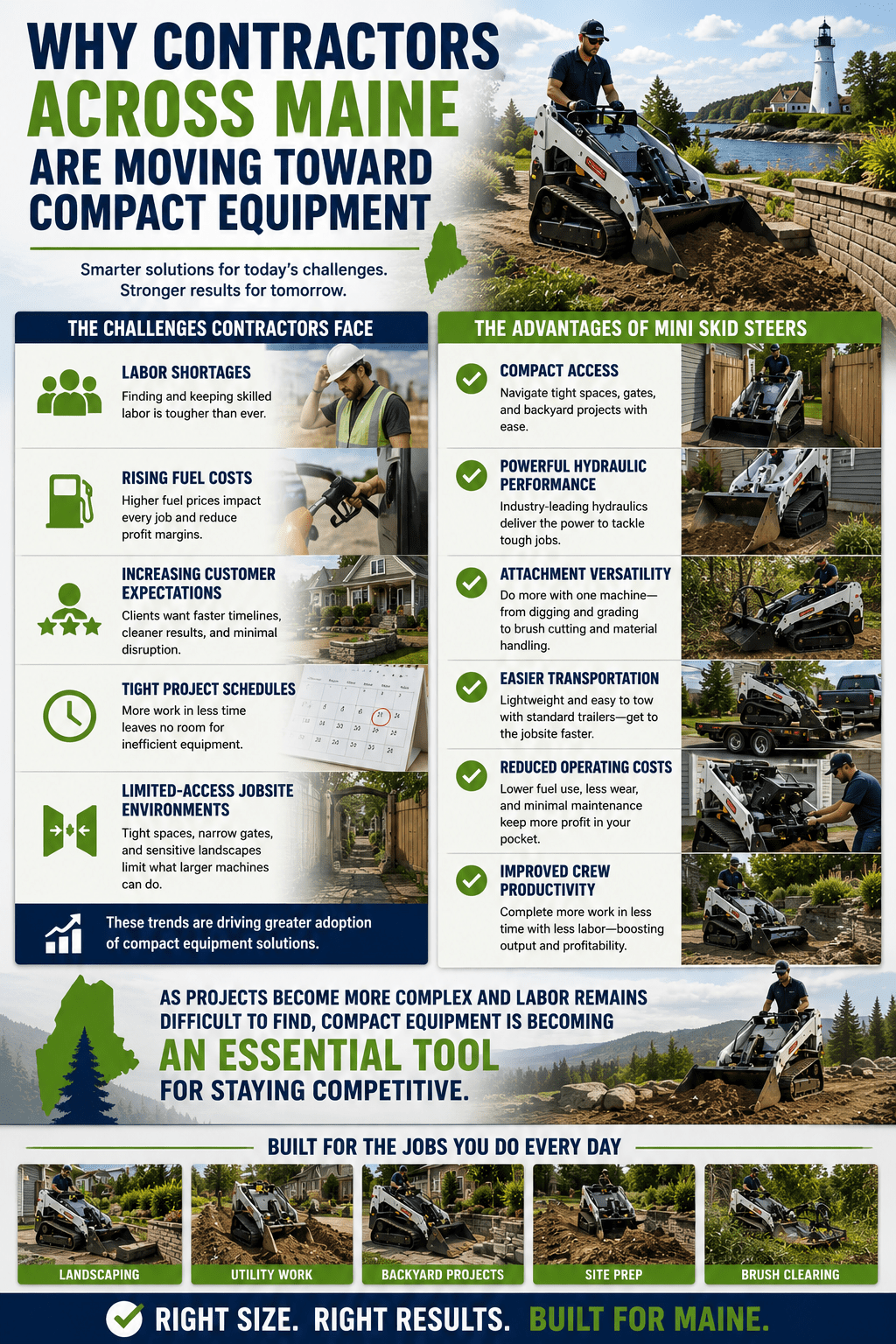
Mini skid steers are specifically designed to solve these access challenges.
Their compact footprint allows contractors to bring mechanized productivity directly into areas where larger machines simply cannot operate.
check out the 480i
Contractor Scenario: The Backyard Transformation
Imagine a landscaping contractor in Bangor tasked with installing a large patio, retaining wall, and drainage system behind an existing home.
The only access point is a 42-inch gate between the house and the property line.
A traditional skid steer cannot enter the space.
Without compact equipment, the crew would need to move materials manually, increasing labor hours dramatically.
A mini skid steer can transport stone, soil, gravel, and construction materials directly into the work zone while operating efficiently within the confined space.
The result:
- Faster completion
- Lower labor costs
- Less employee fatigue
- Greater profitability
- Happier customers
Check out the 450T
Fuel Consumption and Operating Costs Add Up

Equipment ownership involves more than purchase price.
Fuel, maintenance, wear components, and transportation all contribute to total operating costs.
Oversized machines typically consume more fuel and place greater demands on:
- Hydraulic systems
- Tires and tracks
- Engines
- Transport equipment
When those additional costs are spread across numerous small projects, profitability can erode quickly.
Compact equipment allows contractors to match machine size with job requirements, improving operational efficiency while reducing unnecessary expenses.
The Equipment Buying Decision Framework
Build a Machine
Before selecting equipment for your business, ask three simple questions:
1. What percentage of your projects involve limited access?
If the answer is high, compact equipment should be a priority.
2. How much labor is currently spent moving material manually?
Mini skid steers often provide significant labor multiplication on small projects.
3. Are you paying for machine capacity you rarely use?
Many contractors discover they are carrying the cost of oversized equipment while using only a fraction of its capabilities on daily jobs.
Matching equipment size to project requirements often delivers greater returns than simply choosing the largest machine available.
Check out the V1000
Also Read 📖How Mini Skid Steers Are Transforming Construction & Site Development Across New England
The Local Support Advantage
Equipment is only valuable when it's working.
Contractors throughout Maine benefit from having access to local equipment experts who understand regional jobsite conditions, seasonal challenges, and attachment requirements.
Working with a local dealer means:
- Faster support
- Easier access to parts
- Financing assistance
- Equipment recommendations
- Long-term service relationships
That level of support can have a major impact on equipment uptime and overall business success.
🛠️Service & Support
Bigger Isn't Always Better
The most productive contractors are not necessarily using the largest equipment.
They're using the right equipment.
For small jobsites, tight-access projects, residential construction, landscaping, and property improvement work throughout Maine and New England, oversized machines often introduce unnecessary costs that reduce profitability.
Mini skid steers help contractors move materials faster, access confined work areas, reduce labor requirements, minimize property damage, and improve overall jobsite efficiency.
As the market continues shifting toward smaller, more complex projects, compact equipment is proving that smarter often beats bigger.
Also Read 📖The Complete Guide to Buying a Mini Skid Steer: What Every Contractor Should Know Before Investing
☎️Contact

Frequently Asked Questions
1. Why are small jobsites becoming more common across New England?
Small jobsites are increasing due to growing demand for backyard renovations, hardscape projects, utility upgrades, property improvements, infill development, and residential construction in established neighborhoods. Many of these projects require contractors to work in confined spaces where access is limited.
2. What makes small jobsites challenging for contractors?
The biggest challenge is often access rather than workload. Contractors frequently need to work between houses, through narrow gates, around existing landscaping, or within tight urban and suburban properties where larger equipment cannot easily operate.
3. Why isn't larger equipment always the best choice for these projects?
While larger equipment can move more material, it often struggles with maneuverability and access. Oversized machines may require additional labor, create property damage, and increase transportation costs when working in confined areas.
4. What types of projects benefit most from compact equipment?
Projects such as backyard hardscape installations, fence construction, drainage corrections, retaining wall construction, pool installations, residential excavation, and utility service upgrades are often ideal for compact equipment and mini skid steers.
5. Can a mini skid steer fit through a standard residential gate?
Many mini skid steers are specifically designed to fit through standard residential gates and narrow access points, allowing contractors to bring mechanized productivity directly into backyard work areas.
6. How do mini skid steers improve productivity on small jobsites?
Mini skid steers reduce manual labor by transporting materials, digging, grading, lifting, and handling attachments in areas where wheelbarrows and hand labor would otherwise be required. This helps crews complete projects faster and more efficiently.
7. What attachments are commonly used on mini skid steers for small projects?
Popular attachments include buckets, augers, trenchers, grapples, pallet forks, brush cutters, soil conditioners, and grading attachments. These tools allow one machine to perform multiple tasks on a single project.
8. Do compact machines help reduce property damage?
Yes. Mini skid steers generally have a smaller footprint and lower ground pressure than larger machines, helping reduce lawn damage, rutting, landscape disruption, and costly property repairs.
9. Are mini skid steers easier to transport than larger equipment?
Mini skid steers are typically easier and less expensive to transport. Many contractors can tow them using standard trailers and pickup trucks, reducing fuel costs and transportation complexity.
10. How can contractors stay competitive as jobsites become smaller and more complex?
Contractors can stay competitive by investing in equipment that matches modern project demands. Compact equipment and mini skid steers provide the access, versatility, efficiency, and productivity needed to complete tight-access projects profitably while reducing labor requirements and operating costs.


