

The Labor Challenge Facing Contractors Today
Across Maine and New England, contractors are facing a challenge that impacts nearly every project, every estimate, and every growth plan.
Finding skilled workers has become increasingly difficult.
At the same time, labor costs continue to rise, customer expectations are growing, and project schedules remain tight.
Whether you're a landscaper, excavation contractor, property maintenance professional, or residential builder, chances are you've felt the impact firsthand.
The challenge isn't simply finding more work.
The challenge is finding enough people to complete it.
As a result, many contractors are changing their approach. Instead of focusing exclusively on hiring additional workers, they're investing in equipment that helps existing crews become dramatically more productive.
Why Hiring Alone Isn't Solving the Problem
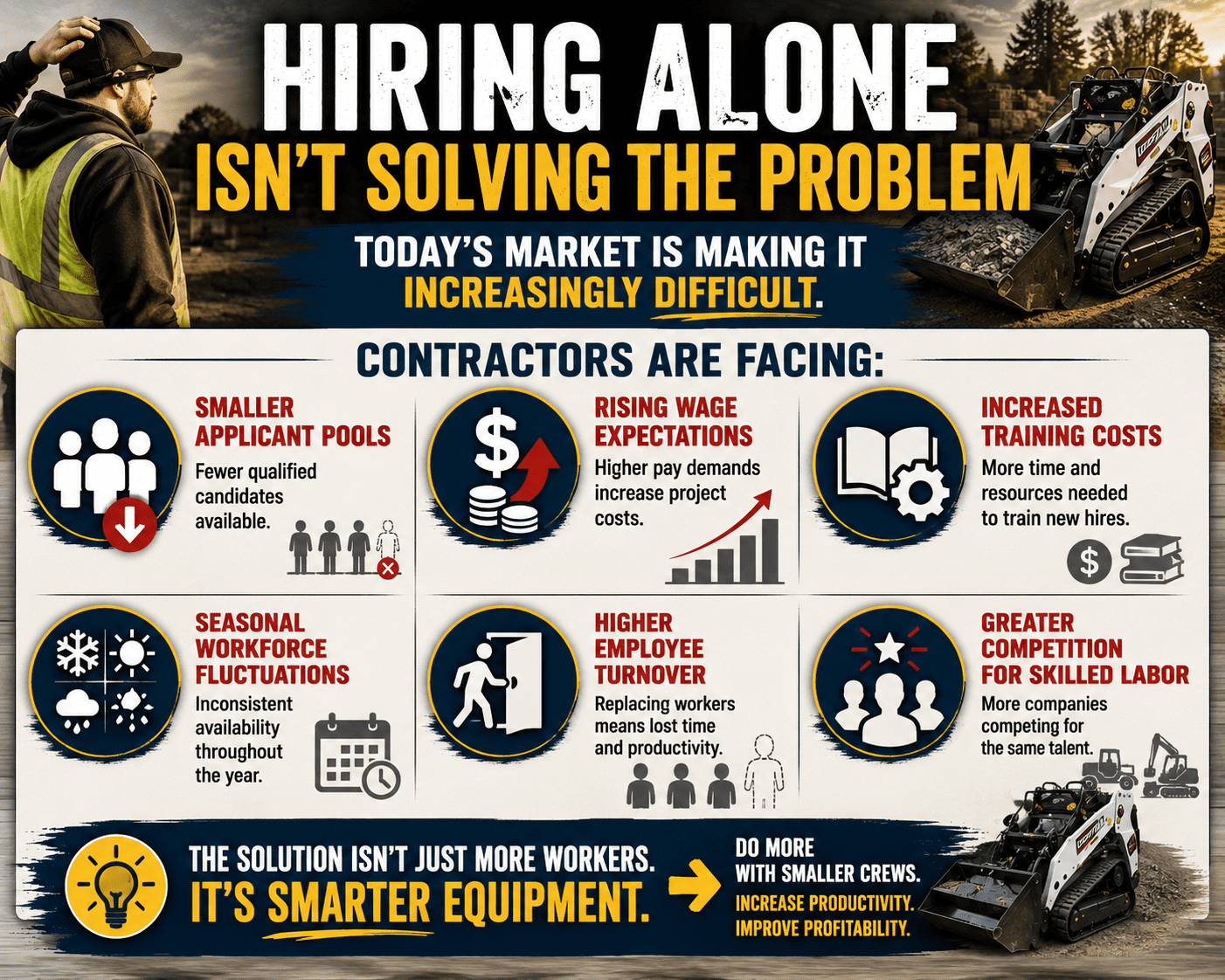
For many contractors, the traditional solution to labor shortages has always been straightforward:
Hire more people.
Unfortunately, today's market is making that increasingly difficult.
Contractors are facing:
- Smaller applicant pools
- Rising wage expectations
- Increased training costs
- Seasonal workforce fluctuations
- Higher employee turnover
- Greater competition for skilled labor
Even when businesses successfully hire new employees, onboarding and training require significant investments of time and money.
For many companies, growth is no longer limited by demand.
It's limited by workforce capacity.
The Rise of the Labor Multiplier
Forward-thinking contractors are beginning to view equipment differently.
Instead of seeing machines as expenses, they're viewing them as productivity multipliers.
A mini skid steer doesn't replace skilled workers.
It amplifies what skilled workers can accomplish.
Rather than assigning multiple crew members to physically move materials, transport debris, or perform repetitive tasks, one operator can often complete those responsibilities quickly and efficiently using compact equipment.
The result is a workforce that accomplishes more with fewer labor hours.
Why Compact Equipment Is Becoming Essential
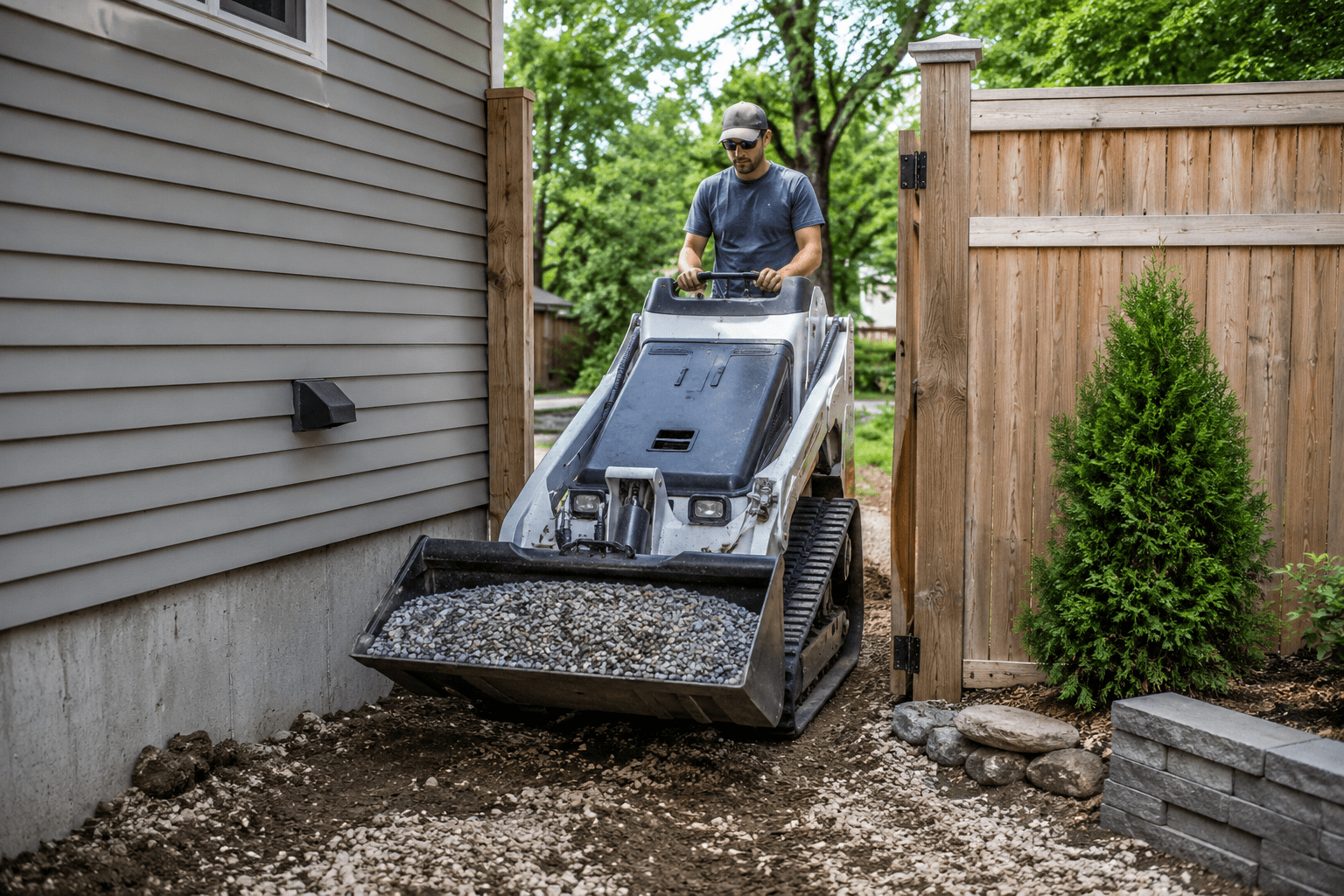
Modern mini skid steers offer contractors a unique combination of power, versatility, and accessibility.
Unlike larger equipment that may struggle in confined work areas, mini skid steers are specifically designed for:
- Tight-access projects
- Residential construction
- Landscaping projects
- Backyard renovations
- Property maintenance work
- Utility upgrades
- Material handling
Their compact size allows crews to bring mechanized productivity directly into areas where manual labor was once the only option.
Also Read 💡Are Oversized Machines Costing Contractors More on Small Jobsites?
Doing More With Smaller Crews
Imagine a landscaping contractor in Bangor handling multiple residential projects each week.
Several years ago, a typical hardscape installation might have required:
- Five crew members
- Multiple wheelbarrows
- Significant manual material handling
- Extended project timelines
Today, the same contractor uses a mini skid steer equipped with the appropriate attachment package.
Now the crew consists of:
- Three team members
- One mini skid steer
- Faster material movement
- Reduced physical strain
- Improved project completion times
The contractor isn't replacing employees.
They're allowing each employee to accomplish more.
The Tasks That Consume Labor Hours
Many labor-intensive activities share a common problem.
They aren't technically difficult.
They're physically demanding and time-consuming.
Examples include:
Material Transportation
Moving stone, mulch, soil, gravel, and debris manually consumes valuable labor hours.
Loading and Unloading
Materials frequently require multiple handling points before reaching their final destination.
Site Preparation
Grading, leveling, and cleanup can significantly slow project timelines.
Debris Removal
Waste material often requires repeated trips by hand or wheelbarrow.
Trenching and Utility Work
Manual trenching increases labor costs and extends project durations.
Compact equipment helps automate many of these repetitive tasks.
Why Maine Contractors Are Making the Shift
Maine presents unique challenges for contractors.
The construction season is often compressed by weather conditions, creating pressure to complete projects quickly.
Contractors must maximize productivity during the months when demand is highest.
Additional challenges include:
- Short construction windows
- Increasing project demand
- Limited workforce availability
- Rising operating costs
- Tight-access residential projects
Compact equipment helps businesses maintain productivity despite these challenges.
Productivity Without Additional Headcount

Many contractors assume growth requires additional employees.
However, growth often comes from increasing output rather than increasing payroll.
Compact equipment helps contractors:
- Complete projects faster
- Reduce manual labor requirements
- Improve crew efficiency
- Increase job capacity
- Reduce employee fatigue
- Improve project profitability
When crews spend less time moving materials manually, they spend more time completing revenue-generating work.
Which Mini Skid Steer Is Right for Building a More Productive Crew?
Every contractor's labor challenge looks a little different. The right machine depends on the type of projects you tackle most often, the materials you move, and the access limitations you encounter on jobsites.
DRT 450T: Ideal for Landscapers and Property Maintenance Professionals

For contractors looking to reduce manual labor on residential projects, the DRT 450T offers an excellent balance of compact size, maneuverability, and productivity. Its stand-on design allows operators to move quickly between tasks while efficiently handling materials, debris, mulch, soil, and hardscape products.
Best for:
- Landscapers
- Property maintenance companies
- Hardscape installers
- Residential contractors
- Acreage owners
DRT 480i: Versatility for Mixed Jobsite Conditions

Contractors who work across multiple project types often appreciate the flexibility of the DRT 480i. Its adaptable design allows crews to tackle everything from landscaping and grading to light excavation and material handling.
Best for:
- Landscape contractors
- Utility contractors
- General contractors
- Property improvement projects
V1000: Built for Growing Contractors

As project volume increases, contractors often need more lifting capacity and greater productivity. The V1000 provides additional power while maintaining the compact footprint necessary for tight-access projects.
Best for:
- Excavation contractors
- Larger landscaping companies
- Site development projects
- Material handling operations
XC1100: Maximum Productivity for Demanding Jobsites

For contractors seeking near full-size skid steer capability in a compact package, the XC1100 delivers exceptional performance. Its increased lifting capacity and robust construction make it an excellent choice for demanding commercial applications.
Best for:
- Commercial landscaping
- Construction companies
- Earthmoving projects
- High-volume contractors
The Future of Construction Productivity
Labor shortages are unlikely to disappear anytime soon.
Contractors who adapt will be the ones best positioned for future growth.
The companies thriving today aren't necessarily hiring the largest crews.
They're building more productive crews.
Mini skid steers and compact equipment allow contractors to increase output, improve efficiency, reduce physical labor demands, and stay competitive in a market where skilled labor remains difficult to find.
Wrapping it up
The labor shortage facing contractors throughout Maine and New England is real, but it doesn't have to limit growth.
Compact equipment provides a practical solution by helping contractors increase productivity without dramatically increasing workforce size.
Mini skid steers enable crews to move materials faster, complete projects more efficiently, reduce labor-intensive tasks, and maximize profitability.
As labor challenges continue to shape the construction, landscaping, excavation, and property maintenance industries, compact equipment is becoming one of the most valuable tools modern contractors can own.
Ready to Build a More Productive Crew?
Labor shortages aren't going away anytime soon. The contractors who thrive over the next decade will be the ones who learn how to accomplish more with the crews they already have.
Whether you're moving materials, installing hardscapes, handling excavation projects, or maintaining properties across Maine and New England, the right mini skid steer can help your team work faster, reduce physical labor, and increase jobsite productivity.
Explore our in-stock machines, compare models, or talk with a local equipment expert about which mini skid steer best fits your business.
📞 Call: 207-401-5131
📍 8 Liberty Drive, Unit C, Hermon, Maine
📧 Aaron@neminiskids.com
View Available Machines: https://neminiskids.com/machines/
Frequently Asked Questions
1. How are labor shortages affecting contractors in Maine and New England?
Labor shortages are making it harder for contractors to staff jobs, complete projects on schedule, and keep up with customer demand. Many landscaping, construction, excavation, and property maintenance businesses are now looking for ways to increase productivity without depending only on hiring more workers.
2. How can compact equipment help solve labor shortages?
Compact equipment helps existing crews accomplish more work in less time. A mini skid steer can move materials, load debris, dig, grade, lift, trench, and support attachment-based work that would otherwise require several workers using hand tools or wheelbarrows.
3. Does a mini skid steer replace workers?
No. A mini skid steer should be viewed as a labor multiplier, not a labor replacement. It helps skilled workers reduce manual strain, move faster, and focus more time on productive project work instead of repetitive material handling.
4. What types of contractors benefit most from mini skid steers?
Mini skid steers are especially useful for landscapers, hardscape installers, excavation contractors, residential builders, property maintenance companies, utility contractors, garden centers, and acreage owners who need compact power in tight or limited-access areas.
5. What jobs can a mini skid steer help with?
Mini skid steers can help with material handling, site preparation, grading, trenching, brush clearing, debris removal, pallet movement, soil transport, mulch spreading, hardscape installation, and general property improvement work.
6. Why are mini skid steers useful for smaller crews?
Mini skid steers allow smaller crews to complete tasks that would normally require extra labor. One operator can move heavy materials, transport supplies, and support multiple jobsite tasks while the rest of the crew focuses on installation, finishing, or skilled trade work.
7. Which attachments improve contractor productivity the most?
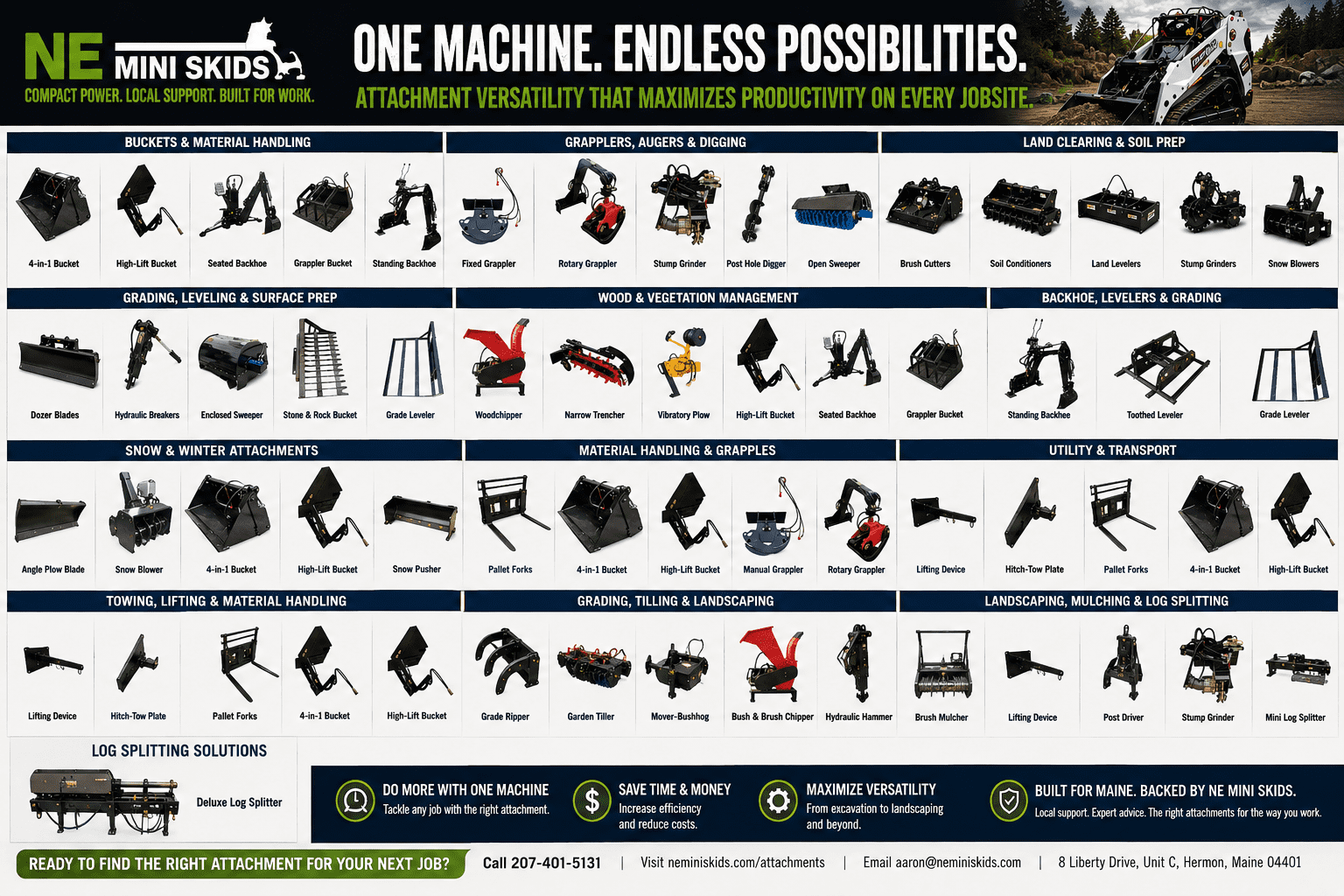
Common productivity-focused attachments include buckets, grapples, augers, trenchers, pallet forks, brush cutters, soil conditioners, backhoes, sweepers, land levelers, and snow attachments. The right attachment depends on the contractor’s daily work and project type.
8. Are mini skid steers easier to transport than larger equipment?
Yes. Mini skid steers are generally easier to transport than larger machines because of their compact size and lighter weight. This can help contractors reduce transportation complexity, improve scheduling flexibility, and move between jobs more efficiently.
9. Which NE Mini Skids machine is best for labor-saving productivity?
The right machine depends on the type of work. The DRT 450T is a strong fit for landscapers and property maintenance work, the DRT 480i is versatile for mixed jobsite conditions, the V1000 supports growing contractors who need more capacity, and the XC1100 is designed for higher-demand commercial and construction use.
10. How can contractors get started with compact equipment?
Contractors can start by reviewing available machines, considering the jobs they perform most often, and talking with a local equipment expert. NE Mini Skids can help contractors compare machines, explore attachments, review financing options, and build a machine that fits their work.


