

🌲 One Property. Dozens of Jobs. One Machine?

Owning land has a way of creating work.
A washed-out driveway needs gravel.
A storm drops branches across a trail.
A fence needs another 300 feet of posts.
A drainage problem appears beside a building.
Brush begins reclaiming the edge of a field.
Then November arrives.
Suddenly, snow management is back on the list.
For property maintenance companies and landowners throughout New England, the problem isn't usually finding something that needs to be done.
It's finding an efficient way to do all of it.
Traditionally, property maintenance has required a mixture of hand labor, rented machines, tractors, specialty equipment, and a collection of tools accumulated over years.
But compact equipment has changed the equation.
A stand-on tracked mini skid steer can serve as a central power platform for dozens of maintenance tasks simply by changing attachments.
That means the same machine carrying gravel in June could be moving storm debris in September and pushing snow in January.
For businesses responsible for multiple properties—or landowners responsible for significant acreage—that versatility deserves a closer look.
Property Maintenance Is Really a Material-Movement Problem
Look closely at most property-maintenance jobs and you'll discover a common denominator:
Something needs to be moved.
It might be:
- Gravel
- Soil
- Mulch
- Logs
- Brush
- Stone
- Snow
- Pallets
- Fence materials
- Drainage stone
- Storm debris
- Firewood
The traditional solution is usually labor.
Load the wheelbarrow.
Push it across the property.
Unload it.
Walk back.
Repeat.
And repeat.
And repeat.
For a homeowner performing an occasional weekend project, that may simply be part of the job.
For a property-maintenance business, however, every unnecessary material-handling hour affects productivity.
If equipment can move the same material while allowing employees to concentrate on skilled work, the economics of the project begin to change.
That is where compact mini skid steers become particularly useful.
Also Read 📖The Complete Guide to Buying a Mini Skid Steer: What Every Contractor Should Know Before Investing
Spring: Repair What Winter Left Behind

New England winters aren't particularly gentle with property.
When spring arrives, maintenance crews frequently encounter:
- Washed-out gravel
- Fallen limbs
- Drainage problems
- Mud
- Erosion
- Damaged trails
- Downed fencing
- Debris
- Rutted access roads
A bucket allows a mini skid to transport gravel, soil, stone, and debris.
A grapple can handle branches, brush, and logs.
A trencher can assist with drainage improvements.
An auger can help replace damaged fence posts.
Instead of bringing several pieces of specialized equipment onto a property, crews can potentially perform multiple operations with the same compact machine.
🚧 A Gravel Driveway Example
Consider a long rural driveway after spring thaw.
Several sections have washed out, while potholes have developed in others.
Repair requires gravel to be moved from the delivery pile to different areas along the driveway.
Doing that manually is impractical.
A mini skid equipped with a bucket can shuttle material where it is needed and assist with spreading and rough grading.
Once that job is complete, the machine can move directly to another task.
That ability to transition between jobs is one of the strongest arguments for compact equipment ownership.
Also Read 📖Why Compact Mini Skid Steers Are Becoming the Smart Choice for Excavation and Earthmoving Projects
Summer: When Property Maintenance Goes Into High Gear
Summer brings an entirely different workload.
Vegetation grows quickly.
Trails need maintenance.
Drainage projects begin.
Landscaping expands.
Fencing gets installed.
Material needs to be moved constantly.
This is where attachment versatility becomes particularly valuable.
Brush and Overgrowth Management
Properties that border woodland, fields, trails, utility corridors, or unused acreage can quickly become overgrown.
A mini skid paired with an appropriate brush-cutting attachment can help manage vegetation in areas accessible to the machine.
A grapple can then help move larger brush, limbs, and debris.
For property-maintenance contractors, this can create an entirely separate service category.
Trail Maintenance
Private estates, campgrounds, farms, recreational properties, municipal land, and larger residential properties may contain extensive trail systems.
Mini skid steers can help:
- Move gravel
- Transport drainage material
- Clear storm debris
- Remove brush
- Repair erosion
- Move logs
- Maintain trail surfaces
Their compact footprint makes them particularly interesting where full-size construction equipment would be cumbersome.
Also Read 📖What is the best mini skid steer for landscaping and hardscaping?
Fall: Cleanup, Clearing and Preparing for Winter
Autumn property maintenance often becomes a race against the calendar.
Storm debris must be cleared.
Drainage needs attention.
Materials need to be relocated.
Wood needs moving.
Properties need to be prepared before the ground freezes.
A grapple attachment can be especially useful during this period.
Rather than cutting branches into tiny pieces so workers can carry them manually, operators can mechanically move larger quantities of brush and debris.
Pallet forks can also become valuable for relocating:
- Bagged materials
- Firewood
- Landscape supplies
- Lumber
- Equipment
- Maintenance materials
This illustrates an important point about mini skid ownership:
The machine's usefulness isn't defined by the bucket.
It's defined by the attachment system.
Also Read 📖How Mini Skid Steers Are Transforming Construction & Site Development Across New England
❄️ Winter: The Machine Doesn't Have to Sit
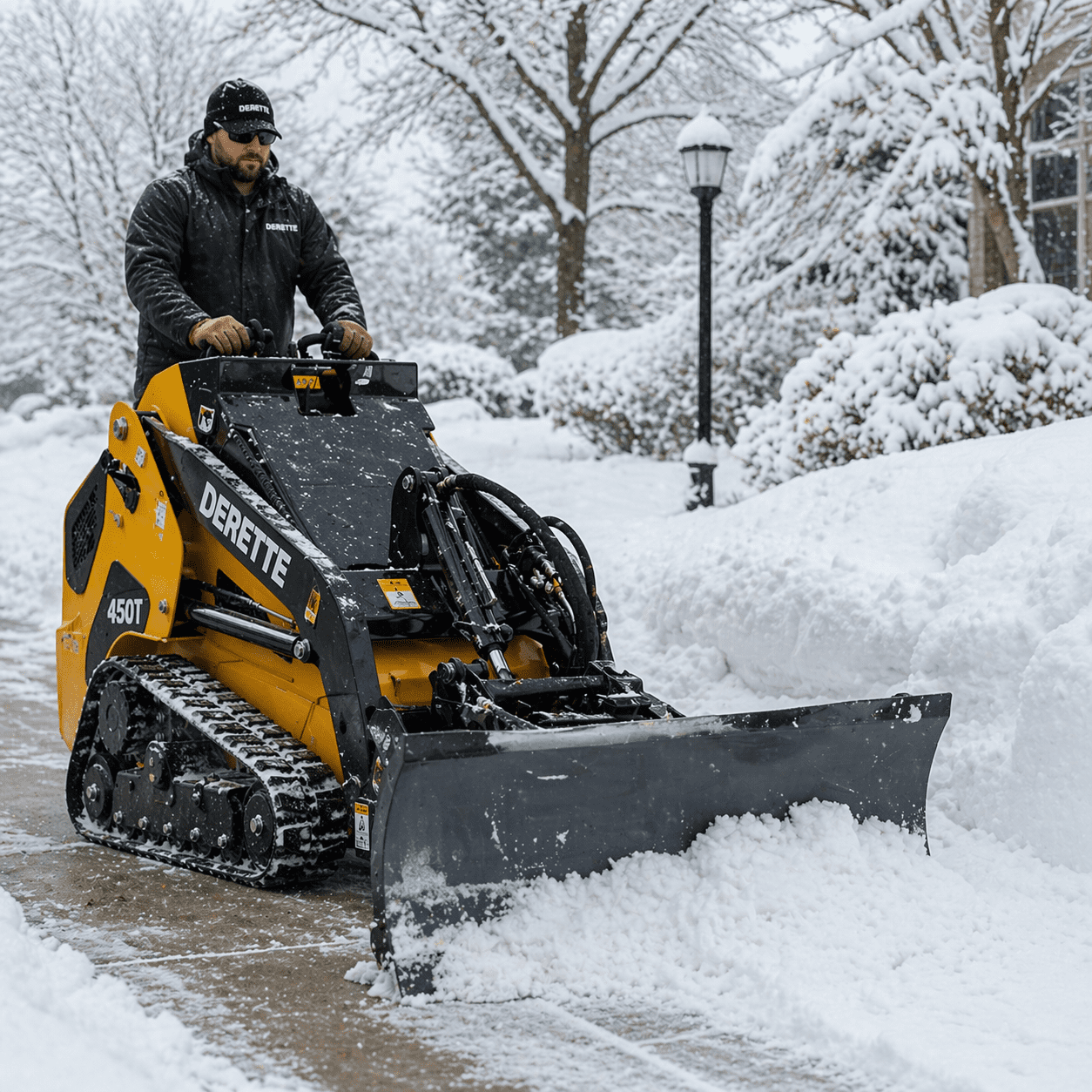
For many contractors, equipment utilization is one of the biggest considerations when evaluating ownership.
A machine that earns its keep for only three months of the year is very different from one that can contribute across multiple seasons.
Snow attachments can extend the working calendar of a mini skid.
Depending on the application and compatible equipment, property-maintenance operations may use snow blades, pushers, buckets, or other snow-handling attachments for areas such as:
- Sidewalk networks
- Apartment properties
- Commercial facilities
- Storage facilities
- Municipal properties
- Private estates
- Farm properties
- Access lanes
- Smaller parking areas
Full-size plow trucks and larger loaders still make sense for large parking lots and roads.
The mini skid fills a different niche.
It can work where those machines become inefficient or simply don't fit.
Also Read 📖Mini Skid Steer Attachments That Deliver the Highest Productivity Gains for Contractors
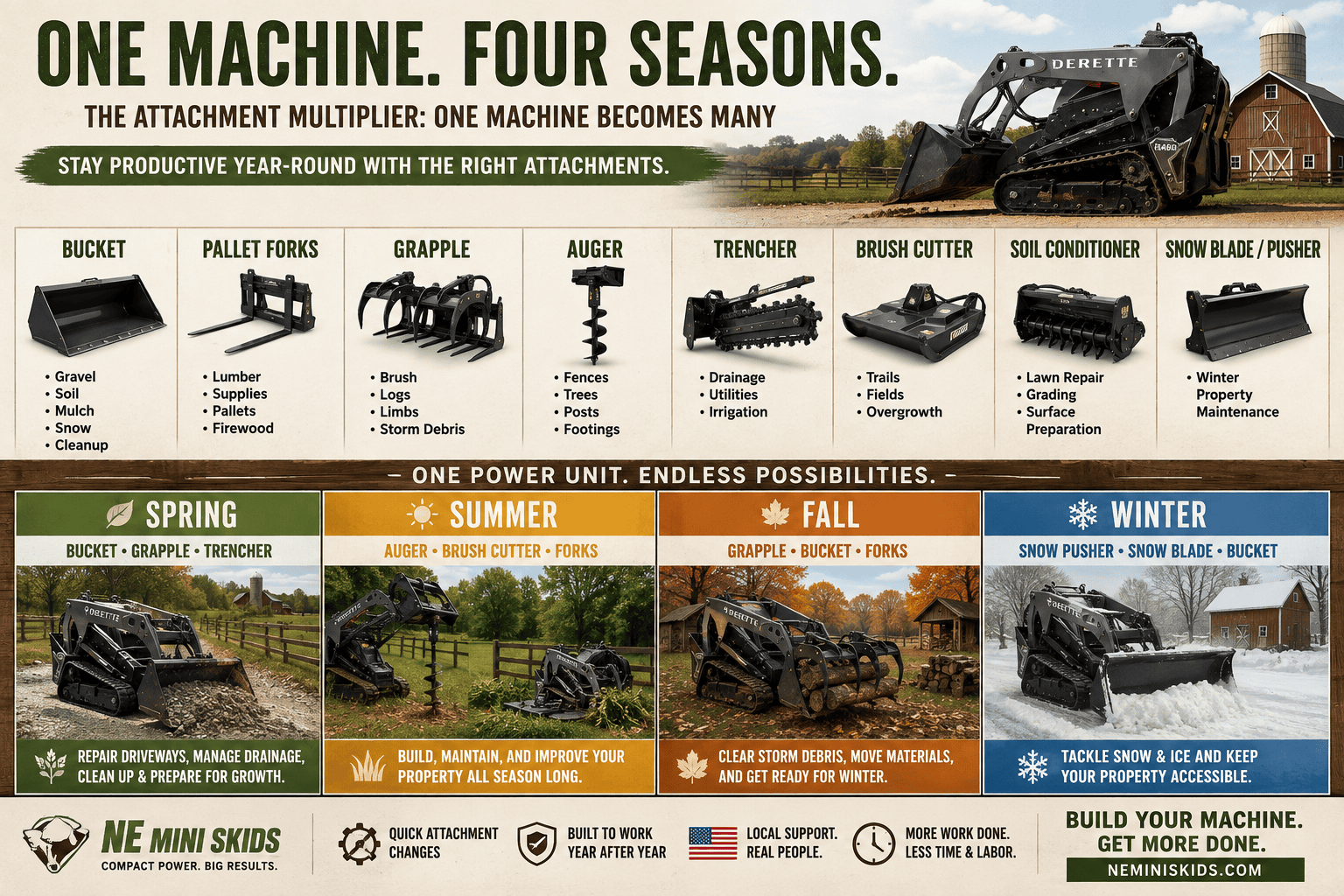
Attachments
The Property Maintenance Scenario: One Machine, One Year

Imagine a New England property-maintenance company responsible for several residential estates and commercial properties.
April
The mini skid repairs gravel washed away during snowmelt.
May
The auger installs fence posts around a customer's property.
June
The bucket transports mulch and soil during landscape improvements.
July
A brush cutter helps reclaim an overgrown section of property.
August
The machine moves drainage stone for a water-management project.
September
Pallet forks transport materials around a commercial property.
October
The grapple removes storm-damaged limbs.
November
The bucket helps prepare gravel access roads before freeze-up.
December through March
Snow equipment supports winter property maintenance.
That's the bigger ownership conversation.
Instead of asking:
"How often would I use a mini skid?"
A better question may be:
"How many jobs am I currently doing manually that this machine could help mechanize?"
Also Read 📖How Contractors Are Solving Labor Shortages with Compact Equipment in Maine
Operational Impact: Reduce the Labor Behind the Job
Property maintenance can be deceptively labor-intensive.
The individual jobs may appear small.
Move a pile of gravel.
Clear some brush.
Repair a fence.
Clean up a fallen tree.
Move a pallet.
But multiply those tasks across dozens of properties and hundreds of working days.
Suddenly, material handling becomes a major labor category.
Mini skid steers don't eliminate skilled employees.
They can make those employees more productive.
Instead of paying someone primarily to push a wheelbarrow, the business can use equipment to handle repetitive transportation while employees focus on:
- Installation
- Repair
- Grading
- Layout
- Finish work
- Customer service
- Skilled maintenance
That distinction becomes increasingly important when reliable labor is difficult to find.
Also Read 📖How Contractors Are Solving Labor Shortages with Compact Equipment in Maine
Compact Size Matters on Established Properties

Property maintenance differs from new construction in one important way:
You are usually working around things the customer already values.
Buildings.
Fences.
Trees.
Gardens.
Walkways.
Lawns.
Pools.
Patios.
Utilities.
Landscape beds.
Bringing oversized equipment into those environments can create another problem while solving the first.
Compact stand-on equipment gives operators another option.
Rather than approaching every property as a construction site, crews can select equipment sized appropriately for confined, established environments.
That's particularly important for residential estates, commercial campuses, municipal properties, and landscaped facilities.

DRT 450T — Compact Property Work
The DRT 450T makes sense when access and maneuverability are major priorities.
Think:
- Residential properties
- Fencing
- Planting
- Mulch
- Soil
- Small material-handling projects
- Lawn work
- Tight-access maintenance
For someone moving beyond hand labor or smaller equipment, this can be a practical starting point.
DRT 480i — The Versatile Property-Maintenance Machine
For many property-maintenance operations, the DRT 480i may represent the sweet spot.
It can support a broader mix of work while maintaining the compact characteristics that make mini skid steers useful.
This makes it especially relevant for companies performing:
- Landscaping
- Drainage
- Trail maintenance
- Material handling
- Fencing
- Brush management
- Property improvements
V1000 — When the Workload Gets Heavier
The V1000 becomes more attractive when property maintenance starts involving heavier material handling and higher production demands.
This can include:
- Larger estates
- Commercial properties
- Farms
- Land-management companies
- Larger landscape operations
- Contractors maintaining multiple properties
XC1100 — Higher-Demand Property Operations
For municipal operations, larger contractors, and land-management businesses where equipment may work heavily and frequently, the XC1100 provides another step in capability.
The important point isn't to automatically move toward the largest machine.
It's to match the equipment to access + workload + attachments + future demand.
Don't Buy for One Season
One of the easiest equipment-buying mistakes is evaluating a machine around a single job.
"I need something for brush."
"I need something for snow."
"I need something for gravel."
That thinking can lead to a collection of specialized machines that each spend much of the year parked.
Instead, consider the entire annual workload.
Ask:
What needs to be moved?
What needs to be dug?
What needs to be cleared?
What needs to be lifted?
What needs to be maintained?
Then determine whether one power unit and several attachments can cover multiple categories.
That's where mini skid ownership can become considerably more compelling.
Build a Machine
Future-Proofing Your Property Maintenance Operation
Compact equipment is becoming increasingly relevant as contractors face pressure to accomplish more work with limited crews.
For a growing property-maintenance company, the long-term opportunity isn't simply replacing manual labor.
It's expanding what the company can offer.
A business that originally performs landscape maintenance may eventually add:
Drainage → fencing → brush clearing → driveway maintenance → storm cleanup → snow management.
Each additional service gives existing customers another reason to call the same contractor.
And that may ultimately be one of the most valuable things a versatile machine provides:
Not just another piece of equipment—but additional capability.
Work Smarter Across All Four Seasons
New England properties never really stop requiring maintenance.
The work simply changes with the season.
Spring brings mud and repairs.
Summer brings construction and vegetation.
Fall brings cleanup and preparation.
Winter brings snow.
A compact mini skid steer gives property owners and maintenance contractors a platform that can change along with that workload.
The DRT 450T can provide compact capability for residential and lighter property work. The DRT 480i expands versatility for growing maintenance operations. The V1000 provides additional capability for larger properties and heavier workloads, while the XC1100 serves higher-demand commercial, municipal, and land-management applications.
The right choice isn't necessarily the biggest machine.
It's the machine that can spend the most time working.
Property Maintenance Equipment Should Earn Its Space
For a property maintenance company, equipment isn't valuable simply because it sits in the yard looking impressive.
It needs to work.
That sounds obvious, but equipment utilization is one of the most important factors to consider before buying any machine.
Imagine two pieces of equipment.
Machine A performs one specialized task extremely well but is needed only occasionally.
Machine B performs several frequently needed tasks and can be adapted with attachments as the workload changes.
For many property maintenance businesses, Machine B may have the greater operational value—even if Machine A outperforms it at one specific task.
That's the advantage of thinking about a mini skid steer as a power platform rather than a single-purpose machine.
A bucket might be attached Monday.
Pallet forks Tuesday.
An auger Wednesday.
A grapple Thursday.
A brush cutter Friday.
And several months later, the machine may be helping with snow management.
The more productive hours a business can reasonably get from a machine, the stronger the ownership argument can become.
The Cost of Doing Everything by Hand
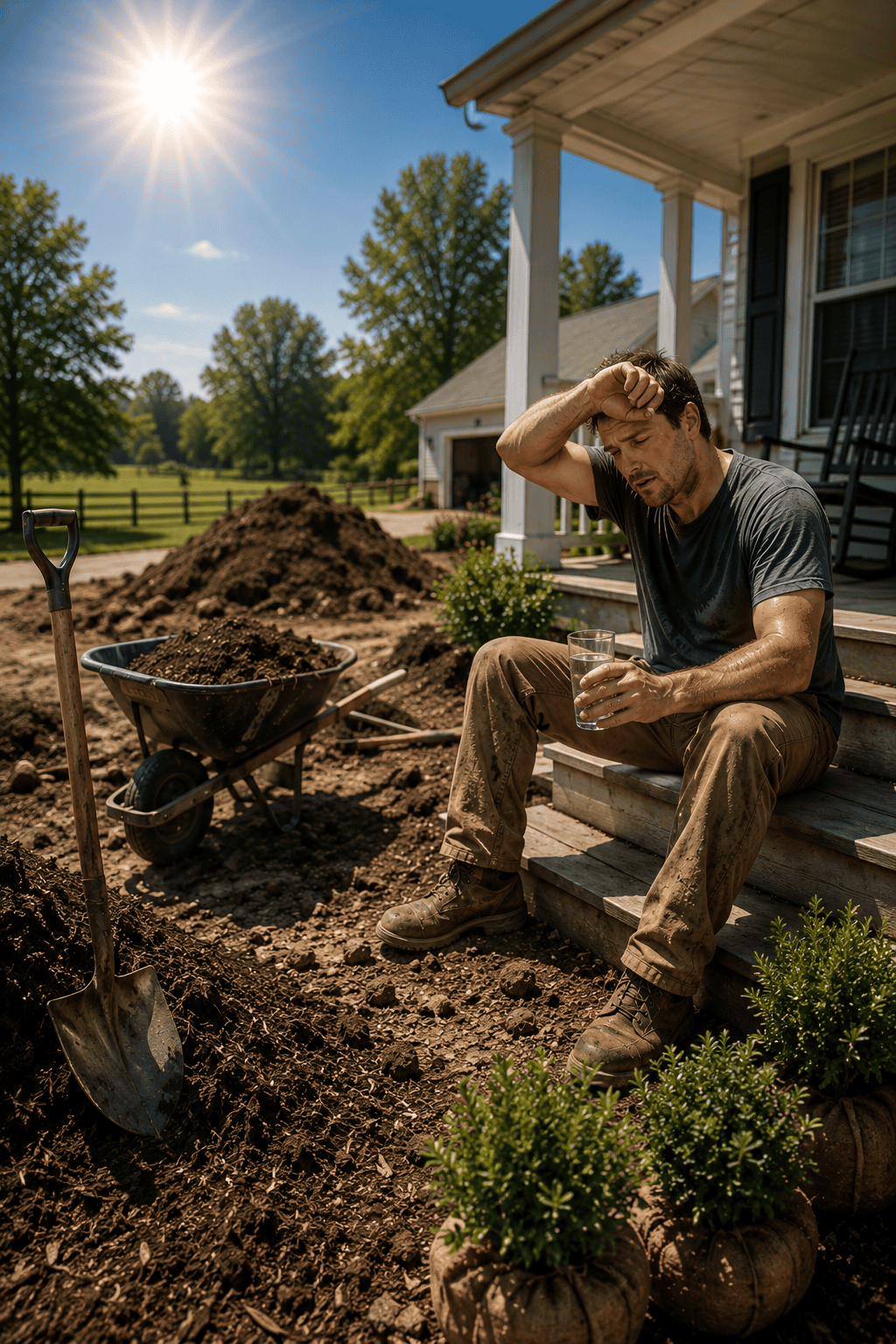
Manual labor doesn't appear on an equipment invoice, which can make it easy to underestimate.
But it certainly appears on payroll.
Consider a property maintenance crew moving gravel from a delivery pile to several locations around a property.
If two employees spend three hours transporting material manually, that's:
2 workers × 3 hours = 6 labor hours
And that's only material movement.
The company still needs to complete the actual repair.
Now multiply similar tasks across an entire season:
- Mulch
- Gravel
- Soil
- Brush
- Logs
- Firewood
- Fence supplies
- Drainage stone
- Snow
- Storm debris
Those hours accumulate.
The objective isn't to claim that a mini skid will replace a specific number of employees or guarantee a certain savings.
Real-world productivity depends on the machine, operator, attachment, material, terrain, access, and project.
But contractors can evaluate their own operations with a simple question:
How many paid labor hours are currently being spent moving things rather than completing skilled work?
That number can help determine whether compact equipment deserves a place in the business.
A Simple Mini Skid Ownership Framework
Before purchasing equipment, calculate what the machine could realistically change.
Step 1 — Estimate Current Manual Labor
Track the number of employee hours spent each month on repetitive material handling.
Step 2 — Calculate Current Rental Costs
Include:
- Equipment rental
- Delivery
- Pickup
- Fuel
- Damage waivers or applicable fees
- Time spent coordinating rentals
Step 3 — Identify Work You're Currently Turning Down
Could equipment allow the company to add:
- Brush clearing?
- Drainage?
- Driveway repair?
- Fence installation?
- Trail maintenance?
- Snow services?
- Storm cleanup?
Step 4 — Estimate Machine Utilization
Don't ask whether you'll use it every day.
Ask:
How many productive hours could the machine realistically work during the year?
Step 5 — Consider Ownership Costs
Include more than the purchase price.
Think about:
- Financing
- Maintenance
- Wear items
- Fuel
- Attachments
- Transportation
- Storage
- Insurance where applicable
Then compare the cost of ownership against the labor, rental expense, scheduling flexibility, and service capacity the machine may provide.
That's a much better buying decision than simply asking:
"How much does the machine cost?"
Renting vs. Owning for Property Maintenance

Rental equipment absolutely has its place.
For occasional specialized work, renting can make excellent financial sense.
But property maintenance creates a unique challenge because many jobs are small and unpredictable.
A storm doesn't schedule itself three weeks ahead.
Neither does a washed-out driveway.
Or a fallen tree.
Or a broken fence.
Or an unexpected drainage problem.
Renting May Make Sense When:
- Equipment is needed only occasionally.
- Projects are predictable.
- The business performs limited equipment-intensive work.
- Storage or transportation is difficult.
- The required machine varies dramatically between projects.
Ownership May Become More Attractive When:
- Equipment is needed repeatedly.
- Rental costs are accumulating.
- Rental availability affects scheduling.
- Crews frequently perform manual material handling.
- The company wants to add equipment-based services.
- Multiple attachments can keep the machine working throughout the year.
The important distinction is frequency.
One job rarely justifies equipment ownership.
Repeated problems can.
Financing
Don't Forget Transportation
One of the practical advantages of compact equipment is transportability.
A full-size skid steer or excavator can require larger trucks, trailers, and additional logistical planning.
Compact mini skid steers can provide another option for contractors whose jobs are spread across multiple properties.
But contractors still need to evaluate the complete transport package.
Consider:
- Machine weight
- Attachment weight
- Trailer capacity
- Tow vehicle ratings
- Tie-down requirements
- Local regulations
- Total loaded weight
A compact machine isn't automatically a lightweight load once several attachments are added to the trailer.
Transportation should be part of the equipment-buying conversation from the beginning—not something discovered after the machine arrives.
Property Access Can Determine Which Machine You Buy
Horsepower and lifting capacity get attention.
Width doesn't get nearly enough.
For property maintenance contractors, access can be one of the most important machine specifications.
Before choosing equipment, look at the properties you regularly service.
Measure:
- Gates
- Side yards
- Walkways
- Paths
- Building clearances
- Landscape openings
- Storage entrances
- Trailer access
A more powerful machine provides little benefit if it can't reach the work.
This is one reason the smaller DRT 450T and DRT 480i can make sense for residential and established-property work.
For larger properties with wider access and heavier workloads, stepping into the V1000 or XC1100 may provide greater capability.
Equipment selection should always balance:
ACCESS + CAPACITY + ATTACHMENTS + WORKLOAD
Five Questions to Ask Before Choosing Your Mini Skid
This makes a strong second visual element for the article.
1. Where Will the Machine Work?
Residential yards?
Commercial properties?
Wooded acreage?
Farms?
Municipal sites?
The environment helps determine the appropriate machine size.
2. What Will You Move Most Often?
Soil?
Gravel?
Stone?
Brush?
Logs?
Snow?
Palletized materials?
Your most common materials should influence machine and attachment selection.
3. Which Attachments Will Actually Make Money?
It's easy to become excited about attachments.
But an attachment that never leaves the equipment yard isn't increasing productivity.
Prioritize attachments around actual customer demand.
4. How Important Is Tight Access?
If most jobs involve narrow gates and established landscapes, compact dimensions may matter more than maximum capacity.
5. Where Will the Business Be in Three Years?
Buying only for today's workload can create another equipment purchase sooner than expected.
Consider reasonable future growth.
Will you add employees?
Take larger properties?
Expand into snow?
Offer drainage?
Add land clearing?
Start handling heavier materials?
Buy enough capability for realistic growth without purchasing unnecessary capacity.
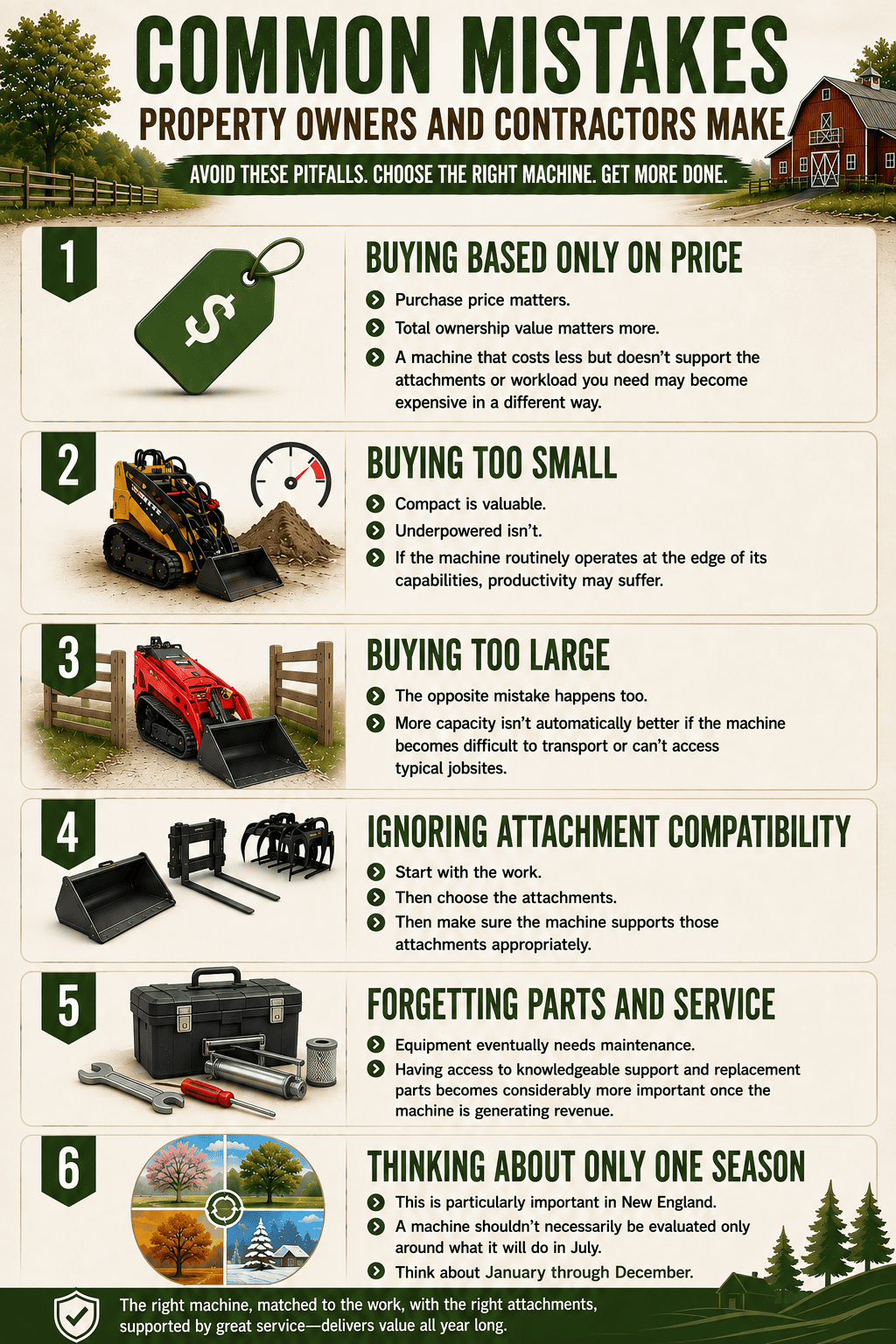
Local Support Matters More After the Sale
Buying equipment online can make machines look like commodities.
They aren't.
The buying experience ends.
Ownership begins.
When equipment becomes part of your daily operation, questions change from:
"How much does it cost?"
to:
"Which attachment fits this application?"
"Can I get the part I need?"
"What maintenance should I be doing?"
"Should I move into a larger machine?"
"Can this attachment handle the work I'm planning?"
That's one reason NE Mini Skids emphasizes local equipment support in addition to machine sales.
For contractors and property owners throughout Maine and New England, access to a local equipment resource can make ownership considerably easier.
Service & Support
Which Mini Skid Should You Start With?
Here's a simpler decision framework.
Choose the DRT 450T when:
Your priority is compact access and lighter property work.
Think residential properties, landscaping, fencing, planting, mulch, soil, and everyday maintenance.
Choose the DRT 480i when:
You want a versatile all-around property maintenance machine capable of supporting a broader attachment and workload mix.
This may be the natural fit for growing property-maintenance and landscape businesses.
Consider the V1000 when:
Material handling becomes heavier and properties become larger.
This is where commercial maintenance, farms, estates, larger landscape operations, and more demanding land work begin entering the conversation.
Consider the XC1100 when:
The operation requires higher production and heavier-duty compact equipment capability, particularly for larger commercial, municipal, or land-management applications.
The Best Machine Isn't Always the Biggest

There's an important lesson running through this entire series:
Equipment should solve the problems your business actually has.
A contractor shouldn't choose the XC1100 simply because it's the largest option.
And another shouldn't choose the DRT 450T simply because the initial investment may be lower.
The correct machine sits at the intersection of:
Jobsite access
Material weight
Attachment requirements
Production expectations
Future business growth
That's the decision NE Mini Skids can help contractors make.
Machines
Future-Proofing: From Property Maintenance to Property Services
There's another reason equipment versatility matters.
Property maintenance businesses often grow horizontally.
A company may begin with landscaping.
Customers then ask:
"Can you fix this drainage problem?"
Then:
"Can you repair the driveway?"
Then:
"Can you clear that brush?"
Then:
"Can you install this fence?"
Then winter arrives:
"Do you handle snow?"
The customer relationship already exists.
The missing piece is often capability.
With the appropriate equipment and attachments, a maintenance company may be able to expand the services it offers existing customers rather than constantly finding new customers.
That's an important distinction.
Equipment doesn't just help perform existing work.
It can sometimes help create new categories of work.
One Machine Should Solve More Than One Problem
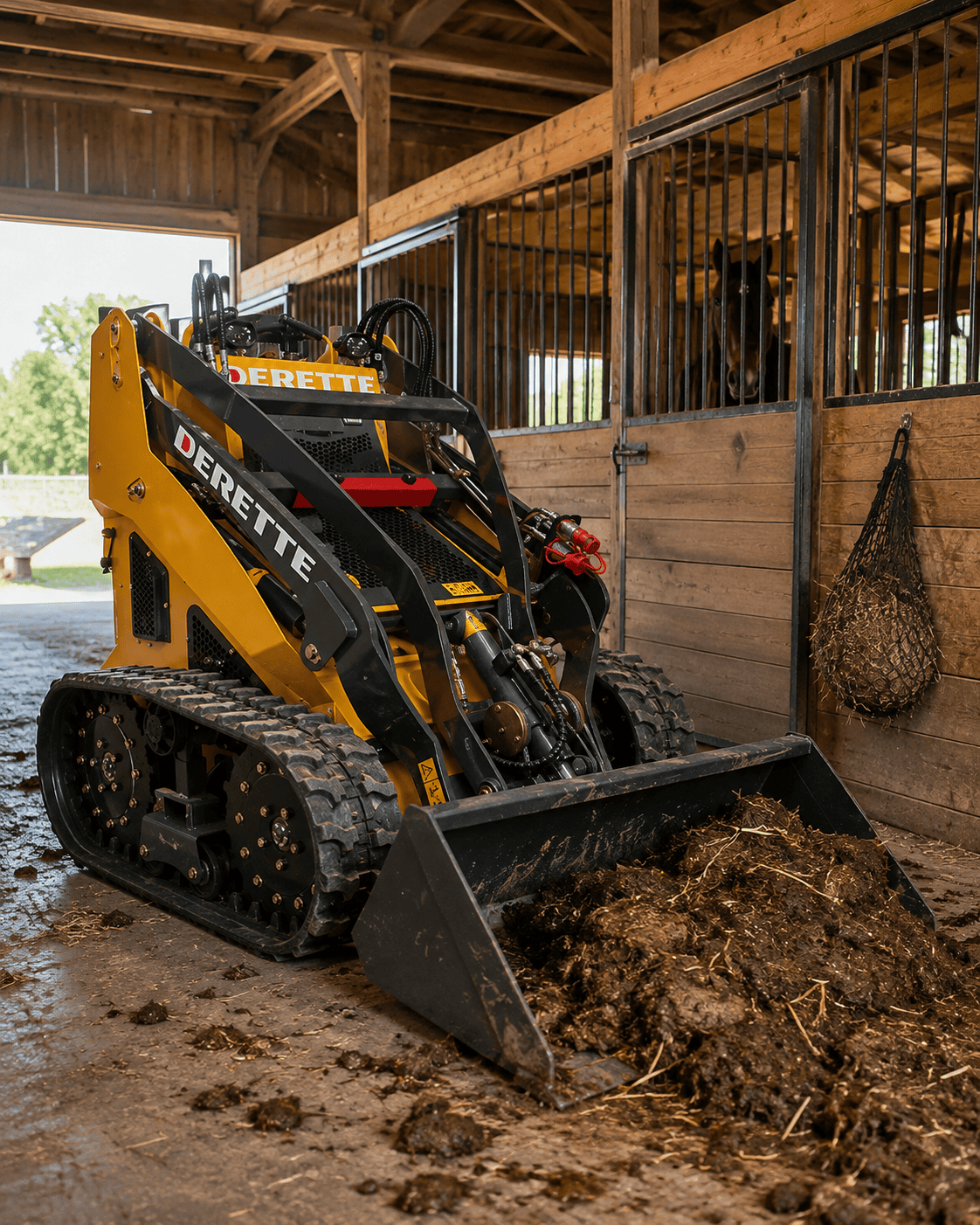
Property maintenance is never one job.
It's hundreds of different jobs spread across four very different seasons.
That's why versatility matters.
A compact tracked mini skid steer can help contractors and property owners move away from an equipment strategy based on individual tasks and toward a system built around a single adaptable power unit with multiple attachments.
Spring might require a bucket and trencher.
Summer might require an auger and brush cutter.
Fall might require forks and a grapple.
Winter might require snow equipment.
The machine stays.
The job changes.
And for many New England property-maintenance operations, that's precisely what makes compact equipment worth considering.
☎️Contact
10 FAQs
1. Is a mini skid steer good for property maintenance?
Yes. Mini skid steers are particularly useful for property maintenance because one compact power unit can perform material handling, brush clearing, driveway repair, fencing, drainage, landscaping, storm cleanup, and snow-management tasks when equipped with appropriate attachments.
2. What can a mini skid steer do on a large property?
A mini skid steer can move gravel and soil, clear brush, transport logs, maintain trails, install fencing, dig holes with an auger, perform drainage work, handle pallets, clean up storm debris, and assist with snow management.
3. What are the best mini skid steer attachments for property maintenance?
Commonly useful attachments include buckets, pallet forks, grapples, augers, trenchers, brush cutters, soil conditioners, and snow blades or pushers. The best combination depends on the property's workload.
4. Can a mini skid steer clear brush and small trees?
A mini skid equipped with compatible brush-management and grapple attachments can help manage vegetation, brush, limbs, and similar debris. Attachment capabilities and machine limitations should always be considered before tackling a particular job.
5. Can a mini skid steer repair a gravel driveway?
Yes. A bucket-equipped mini skid can transport gravel to washed-out areas, fill potholes, redistribute material, and assist with rough grading during gravel driveway maintenance.
6. Can mini skid steers be used for trail maintenance?
Yes. Their compact footprint can make mini skid steers useful for moving gravel, repairing erosion, clearing storm debris, transporting drainage materials, and managing vegetation on accessible trails.
7. Can I use a mini skid steer during winter?
Yes. With compatible snow attachments, mini skid steers can assist with snow management on sidewalks, access lanes, commercial properties, estates, and other areas where larger snow equipment may be less practical.
8. Which NE Mini Skid is best for property maintenance?
The appropriate machine depends on workload and access. The DRT 450T is suited to compact residential maintenance, while the DRT 480i offers broader versatility. The V1000 can serve heavier commercial and land-management applications, while the XC1100 is positioned for higher-demand operations.
9. Should a property maintenance company rent or buy a mini skid steer?
Renting may make sense for occasional equipment needs. Ownership becomes worth evaluating when the machine is required frequently, rental expenses accumulate, availability affects scheduling, or multiple attachments could keep the machine productive across several services and seasons.
10. Why buy property-maintenance equipment from NE Mini Skids?
NE Mini Skids helps New England contractors and property owners evaluate compact equipment based on actual workloads, attachments, access requirements, and future growth. Buyers can also access machine options, financing, parts, service support, and assistance building an equipment package around the work they perform.
Conclusion: One Machine, More Capability, All Year Long

Ready to Build a Machine Around the Work You Actually Do?
NE Mini Skids can help you compare the DRT 450T, DRT 480i, V1000, and XC1100 based on your property access, workload, attachments, transportation requirements, and future plans.
Don't start with:
"What's the biggest machine?"
Start with:
"What do I need this machine to accomplish?"
Then build from there.
👉 Explore Available Machines:
https://neminiskids.com/machines/
👉 Build Your Machine:
https://neminiskids.com/build-your-machine/
📞 207-401-5131
📧 Aaron@neminiskids.com
📍 8 Liberty Drive, Unit C, Hermon, Maine 04401
Get more done. Reduce labor demands. Work smarter with compact equipment built for today's jobsites.


