

Hydraulic Flow Explained: Why GPM Matters More Than Many Mini Skid Buyers Realize
Estimated Read Time: 8–10 minutes
Executive Brief
Hydraulic flow is a critical consideration when evaluating mini skid steer performance. GPM measures the volume of hydraulic fluid delivered over time, while PSI measures hydraulic pressure. Together, these factors determine the hydraulic power available to attachments.
A machine with sufficient lifting capacity may still lack the hydraulic flow or pressure needed for a demanding attachment. Buyers should evaluate both machine and attachment specifications before purchasing, particularly when planning to operate hydraulic tools regularly.
The best equipment investment is not necessarily the machine with the highest horsepower or greatest lift capacity. It is the machine whose hydraulic capabilities match the work the contractor intends to perform.
Key Takeaways
- GPM affects attachment operating speed. Hydraulic motors and cylinders depend on adequate fluid flow.
- PSI and GPM perform different functions. Flow influences speed, while pressure contributes to the force or torque available.
- Horsepower does not automatically equal hydraulic performance. Engine output and usable auxiliary hydraulic power are different specifications.
- Attachment compatibility matters. Both insufficient and excessive hydraulic flow can create operating problems.
- Hydraulic performance influences productivity. Properly matched equipment can reduce delays, overheating risks, and inefficient operation.
- Buy for your workload. Evaluate the hydraulic demands of your most important attachments before choosing a mini skid steer.
A mini skid steer can have impressive lifting capacity, a powerful engine, and a compact footprint—but if its hydraulic system cannot properly support your attachments, you may never experience the productivity you expected from your investment.
When contractors shop for mini skid steers, they often compare horsepower, operating weight, rated operating capacity, and machine dimensions. Those specifications are important, but one measurement deserves considerably more attention: hydraulic flow, measured in gallons per minute (GPM).
Hydraulic flow influences how quickly certain attachments operate, how effectively a machine delivers hydraulic power, and whether specialized equipment can perform as intended.
For contractors who rely on augers, trenchers, brush cutters, and other hydraulically powered attachments, understanding GPM can be the difference between purchasing a versatile workhorse and discovering an expensive compatibility problem.
What Is Hydraulic Flow on a Mini Skid Steer?
A mini skid steer's hydraulic system transfers mechanical power from the machine's engine to hydraulic motors and cylinders.
The engine drives a hydraulic pump, which moves hydraulic fluid through the system. This pressurized fluid can operate the machine's drive system, loader functions, and auxiliary attachments.
Hydraulic flow describes how much fluid moves through the system during a specific period.
In the United States, flow is commonly measured in gallons per minute, or GPM.
For example, a hydraulic system delivering 12 GPM moves 12 gallons of hydraulic fluid through a specified circuit every minute under the stated operating conditions.
That measurement matters because many attachments use hydraulic motors to produce rotational movement.
Consider a hydraulically powered trencher. Its digging chain depends on hydraulic motor speed and torque. If the host machine cannot provide the attachment's required flow and pressure, the trencher may operate below its intended performance range.
However, more GPM is not automatically better. Every hydraulic attachment has a designed operating range.
The objective is to match the machine's available hydraulic output with the attachment manufacturer's requirements.
Also Read 📖Tracks vs. Wheels: Which Mini Skid Steer Is Better?
Why Auxiliary Hydraulic Flow Is Especially Important
Mini skid steers often have separate hydraulic functions serving propulsion, lifting, and attachments.
When comparing machines, buyers should specifically identify the rated auxiliary hydraulic flow available at the attachment couplers, rather than assuming that total pump capacity is available to an attachment.
That distinction can prevent a costly misunderstanding.
A machine's published hydraulic specifications may include several different flow measurements. Only the appropriate auxiliary circuit rating tells you what the attachment can actually receive.
GPM vs. PSI: Understanding the Difference
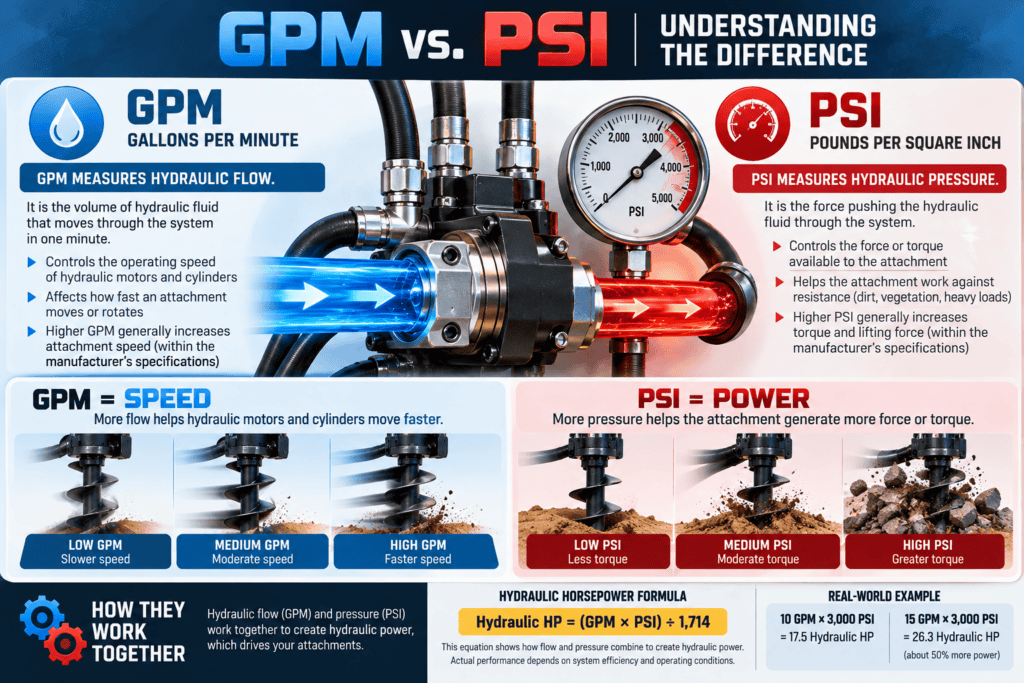
GPM and PSI are frequently discussed together, but they measure different hydraulic characteristics.
GPM (Gallons Per Minute) measures hydraulic fluid flow rate.
PSI (Pounds Per Square Inch) measures hydraulic pressure.
For a hydraulic motor, flow primarily influences rotational speed, while pressure differential contributes to available torque.
Both are essential to hydraulic performance.
How Hydraulic Power Is Calculated
A commonly used theoretical hydraulic horsepower equation is:
Hydraulic Horsepower = (GPM × PSI) ÷ 1,714
This equation estimates hydraulic power transmitted by fluid at a given flow and pressure. It does not account for the mechanical and volumetric losses present in real equipment.
Consider two hypothetical hydraulic systems:
| Hydraulic System | Flow | Pressure | Theoretical Hydraulic HP |
|---|---|---|---|
| System A | 10 GPM | 3,000 PSI | 17.5 HP |
| System B | 15 GPM | 3,000 PSI | 26.3 HP |
At the same pressure, System B delivers approximately 50% more theoretical hydraulic power because it moves 50% more fluid per minute.
That additional hydraulic power can be valuable when operating appropriately matched, power-demanding attachments.
But there is an important limitation: these figures represent theoretical output at the stated conditions. Actual available power depends on pump performance, system efficiency, pressure losses, temperature, and operating conditions.
The takeaway: Engine horsepower tells you about the engine. Hydraulic GPM and PSI help tell you what power may be available to the attachment.
Why Hydraulic Flow Matters for Attachment Performance
The value of hydraulic flow becomes clearer when examining the tools contractors use every day.
Different attachments demand different combinations of flow, pressure, torque, and operating speed.
Augers: Drilling Speed and Torque
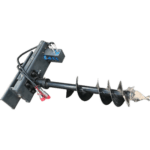
Hydraulic augers are frequently used for fence posts, foundations, landscaping, and agricultural installations.
Their performance depends on both rotational speed and drilling torque.
Flow influences auger motor speed, while available pressure and motor displacement affect torque.
Insufficient flow may result in slower rotation, while inadequate pressure can limit the auger's ability to turn under heavy resistance.
A larger GPM rating alone does not guarantee better drilling performance, particularly in difficult soils.
Trenchers: Consistent Chain Movement

Trenchers depend on hydraulic power to drive a digging chain through soil.
When flow is insufficient, the chain may operate more slowly than intended, potentially reducing trenching productivity.
If the hydraulic system also lacks adequate pressure, the attachment may struggle under increased digging resistance.
Proper hydraulic matching helps the trencher maintain performance within its designed operating range.
Bush Cutters: Maintaining Cutting Performance
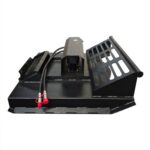
Bush cutters are among the attachments where hydraulic compatibility can become particularly important.
A hydraulic cutter must maintain adequate blade or rotor speed while handling vegetation resistance.
An undersupplied attachment may lose rotational speed more readily when the cutting load increases.
The hydraulic system must provide both sufficient flow and usable pressure to support the cutter's design.
Buyers should always verify the cutter manufacturer's required flow range, pressure limits, case-drain requirements, and other connection specifications.
Grapples: A Different Hydraulic Requirement

Not every hydraulic attachment requires continuous high-volume flow.
Many grapple attachments use hydraulic cylinders to open and close their jaws rather than a continuously rotating hydraulic motor.
Their hydraulic requirements may be comparatively modest, although sufficient pressure, flow, and correct control functions are still necessary.
This illustrates why purchasing the machine with the highest available GPM is not always the most economical choice.
Different attachments place different demands on the hydraulic system.
What Happens When Hydraulic Flow Is Too Low—or Too High?
Hydraulic compatibility involves more than simply connecting hoses.
When Flow Is Too Low
If a mini skid steer supplies less hydraulic flow than an attachment requires, the operator may experience:
- Slower attachment operating speeds
- Reduced cutting or digging productivity
- Difficulty maintaining intended rotational speed under load
- Longer task completion times
- Performance below the attachment manufacturer's specifications
Insufficient flow does not automatically damage an attachment, but it can prevent the tool from operating effectively.
When Flow Is Too High
Excessive hydraulic flow can also create problems.
Depending on the attachment and hydraulic circuit, supplying more flow than the manufacturer permits may result in:
- Excessive motor or rotor speed
- Increased heat generation
- Accelerated component wear
- Hydraulic seal or motor damage
- Operation outside the attachment's safe design limits
Some attachments include flow controls or other protective features, but buyers should never assume that an attachment can safely accommodate any hydraulic output.
Why Hydraulic Pressure Must Also Be Checked
Even when flow matches, excessive pressure can exceed an attachment's rated limits.
Conversely, a machine may provide the correct flow but insufficient pressure to achieve the required torque or force.
This is why hydraulic compatibility must be evaluated as a combination of specifications—not a single number.
Also Read 📖The Complete Guide to Buying a Mini Skid Steer: What Every Contractor Should Know Before Investing
How Hydraulic Flow Affects Jobsite Productivity
For contractors, hydraulic performance is not simply a technical specification. It can affect labor efficiency and project profitability.
Consider a hypothetical landscaping contractor operating a hydraulic trencher.
Suppose an attachment and machine combination completes a particular trenching operation in 60 minutes.
A different, properly matched combination might complete the same work in 45 minutes under comparable conditions.
That represents a 25% reduction in task time.
Over 100 similar jobs, the difference would equal 25 labor hours.
This is an illustration, not a promised performance improvement. Actual productivity depends on soil conditions, operator experience, attachment design, machine stability, available power, and other factors.
Nevertheless, the business principle is important.
A hydraulic mismatch can turn equipment capability into wasted operating time.
Contractors should evaluate not only what a machine can lift, but how efficiently it can power the attachments responsible for generating revenue.
Also Read 📖Complete Mini Skid Steer Guide for New England Contractors
How to Evaluate Hydraulic Requirements Before Buying

Before purchasing a mini skid steer, contractors should identify the attachments they currently use and those they expect to add.
A machine that performs well with a bucket or pallet forks may not provide sufficient auxiliary hydraulic capability for every motor-driven attachment.
Use the following checklist:
Step 1: Identify your primary attachments.
List the equipment that will perform the greatest share of your work, such as augers, trenchers, cutters, grapples, or specialized tools.
Step 2: Record each attachment's hydraulic specifications.
Look for required or recommended GPM, maximum allowable PSI, hydraulic motor specifications, and any additional requirements.
Step 3: Confirm the mini skid steer's auxiliary hydraulic output.
Check the manufacturer's rated auxiliary flow and pressure, including the operating conditions under which those ratings apply.
Step 4: Verify hydraulic connections and controls.
Confirm coupler compatibility, hose sizing, auxiliary control functions, and whether the attachment requires a case drain or other return-line arrangement.
Step 5: Consider simultaneous hydraulic demands.
Some operating tasks require propulsion, loader functions, and attachment operation at the same time.
Determine whether the machine can maintain sufficient attachment performance during the work you intend to perform.
Step 6: Evaluate future attachment purchases.
If your business expects to expand into vegetation management, trenching, or other specialized services, consider those hydraulic requirements before selecting a machine.
Step 7: Request a demonstration when possible.
A properly conducted demonstration using a representative attachment can reveal performance characteristics that are difficult to judge from a specification sheet alone.
Choosing the Right Mini Skid Steer at NE Mini Skids
NE Mini Skids offers contractors an opportunity to compare compact equipment based on more than physical size and lifting capacity.
For buyers considering the Derette DRT 450T, DRT 480i, V1000, or XC1100, hydraulic specifications should be reviewed alongside machine dimensions, operating capacity, and intended applications.
Rather than assuming that the largest or most powerful-looking machine will automatically deliver the best attachment performance, buyers should ask:
- Which model provides the auxiliary hydraulic flow required by my attachments?
- What hydraulic pressure is available at the auxiliary circuit?
- Can the machine support my most demanding attachment?
- Are additional hydraulic connections or controls required?
- Which machine offers the best balance of hydraulic capability, lift capacity, physical dimensions, and operating cost?
Published specifications and available configurations should be confirmed with NE Mini Skids before purchase.
For a broader discussion of equipment sizing, read our related guide:
How Much Mini Skid Steer Do You Really Need?
Understanding machine size and lifting capacity is an important first step. Evaluating hydraulic compatibility helps complete the purchasing decision.
Also Read 📖How Mini Skid Steers Are Transforming Construction & Site Development Across New England
Conclusion: The Right Hydraulic Match Is More Valuable Than a Big Number
Mini skid steer buyers have good reasons to compare horsepower, lifting capacity, and machine weight.
But hydraulic flow deserves a place near the top of that comparison.
GPM influences the operating speed of many hydraulic attachments, while PSI contributes to their available force and torque. Together, these specifications help determine whether a machine can effectively power the tools required for the job.
For contractors investing in equipment to improve productivity, a hydraulic mismatch can lead to disappointing performance, reduced efficiency, and unnecessary costs.
The smartest mini skid steer purchase is not necessarily the machine with the highest GPM. It is the machine with the right hydraulic capabilities for your attachments, applications, and future workload.
Find the Right Mini Skid Steer for Your Work
Before investing in your next machine, talk with NE Mini Skids about the attachments you plan to operate and the hydraulic specifications they require.
Our team can help you compare equipment options and determine which models deserve a closer look for your applications.
Explore Mini Skid Steers and Contact NE Mini Skids


10 Frequently Asked Questions About Mini Skid Steer Hydraulic Flow
1. What is hydraulic flow on a mini skid steer?
Hydraulic flow is the volume of hydraulic fluid delivered through a mini skid steer's hydraulic system, measured in gallons per minute (GPM). It influences how quickly hydraulic motors and cylinders operate. Auxiliary hydraulic flow is particularly important because it determines whether the machine can properly operate attachments such as augers, trenchers, brush cutters, and other hydraulic-powered tools.
2. How much GPM does a mini skid steer need?
The amount of hydraulic flow a mini skid steer needs depends on the attachments it will operate. Some attachments require relatively low flow, while others need greater hydraulic output to perform efficiently. Buyers should compare the machine's rated auxiliary GPM with each attachment manufacturer's recommended flow range. Choosing a machine with compatible hydraulic specifications helps ensure proper attachment performance.
3. What is the difference between GPM and PSI on a mini skid steer?
GPM measures hydraulic fluid flow, while PSI measures hydraulic pressure. Flow primarily influences the operating speed of hydraulic motors and cylinders, while pressure contributes to the torque or force they can generate. Both measurements affect attachment performance. A mini skid steer must provide sufficient hydraulic flow and pressure to operate an attachment within its manufacturer's specifications.
4. Does higher GPM make a mini skid steer more powerful?
Higher GPM can increase the hydraulic power available to an attachment when sufficient pressure is also maintained. However, higher flow does not automatically mean better performance. Attachments have specific operating ranges, and excessive flow can cause overspeed or equipment damage. The best hydraulic system is one that delivers the appropriate combination of flow and pressure for the intended application.
5. Can a mini skid steer operate attachments that require more GPM than it provides?
A mini skid steer may physically connect to an attachment that requires more GPM than the machine provides, but the attachment may operate below its intended performance level. Reduced hydraulic flow can result in slower motor speeds, lower productivity, or inadequate performance under demanding conditions. Always confirm the attachment's minimum hydraulic requirements before operating it.
6. Which mini skid steer attachments require the most hydraulic flow?
Hydraulic brush cutters, forestry attachments, trenchers, and certain specialized tools can require substantial hydraulic flow, depending on their design. Augers also have specific hydraulic requirements, although their performance depends on both rotational speed and torque. Grapples that use hydraulic cylinders may require less continuous flow. Buyers should verify the manufacturer's specifications rather than assuming all attachments within a category have identical requirements.
7. Can too much hydraulic flow damage a mini skid steer attachment?
Yes. Supplying hydraulic flow above an attachment's rated maximum can cause hydraulic motors or rotating components to operate faster than their intended limits. Depending on the attachment, excessive flow may contribute to overheating, premature wear, or mechanical damage. Hydraulic pressure limits must also be respected. Always follow the attachment manufacturer's approved flow and pressure specifications.
8. Is engine horsepower more important than hydraulic flow when buying a mini skid steer?
Engine horsepower and hydraulic flow are both important, but they describe different capabilities. Engine horsepower represents the engine's mechanical power output, while auxiliary hydraulic flow and pressure help determine the hydraulic power available to attachments. Contractors using motor-driven attachments should evaluate both specifications. A powerful engine does not necessarily guarantee sufficient auxiliary hydraulic performance for every attachment.
9. How can I check whether a hydraulic attachment is compatible with my mini skid steer?
Start by comparing the attachment's required GPM and allowable PSI with the mini skid steer's rated auxiliary hydraulic output. Next, verify hydraulic coupler compatibility, hose requirements, control functions, and whether a case drain or specialized return line is necessary. Buyers should also consider whether the machine can maintain attachment performance while driving or operating other hydraulic functions. A dealer-assisted compatibility review can help prevent purchasing mistakes.
10. How do I choose the best mini skid steer for hydraulic attachments?
Choose a mini skid steer by identifying the attachments you use most frequently and comparing their hydraulic requirements with the machine's auxiliary flow and pressure ratings. Also evaluate lifting capacity, machine dimensions, jobsite conditions, and future equipment needs. NE Mini Skids can help buyers compare available Derette mini skid steer models and determine which options are worth considering for their intended applications. Visit NE Mini Skids to explore equipment and request additional information.
Read previous Article: What Size Mini Skid Steer Do I Need? | NE Mini Skids
Next Article: Mini Skid Steer Attachments: Which Ones Should You Buy First?


