

How Much Mini Skid Steer Do You Really Need? Lift Capacity, Hydraulics & Machine Size Explained
⏱️ Estimated Read Time: 7–8 Minutes
Executive Summary
Choosing the right mini skid steer is not simply a matter of buying the machine with the highest lift capacity or the most horsepower. The best machine is the one that matches the work you perform most often while providing enough capability for the attachments, materials, terrain, and operating conditions your business encounters.
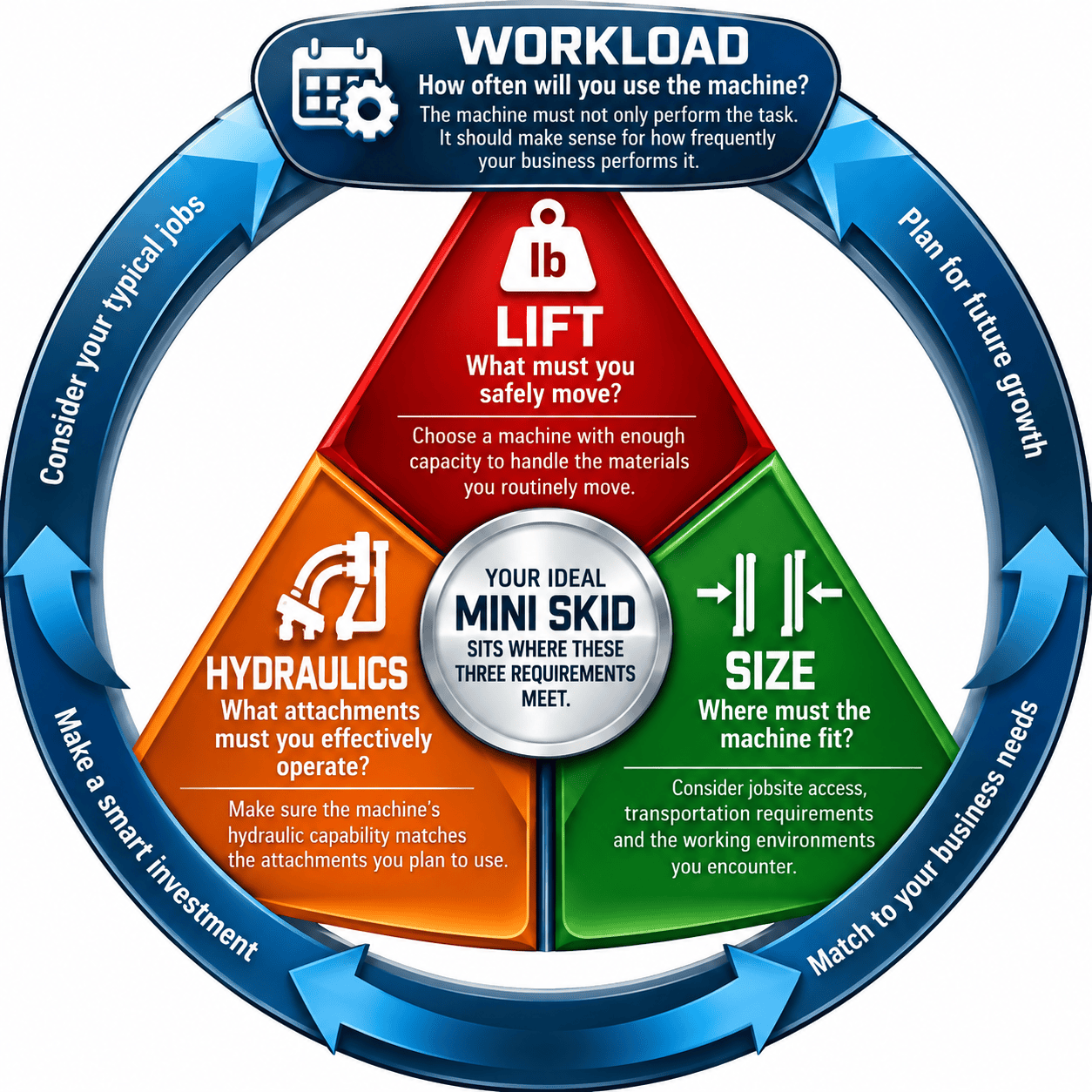
Four factors should guide the decision: lift capacity, hydraulic requirements, physical machine size, and workload.
Lift capacity determines whether the machine can safely handle the materials you routinely move. Hydraulic capability becomes increasingly important when attachments such as augers, trenchers, grapples, stump grinders, and other powered tools are part of the plan. Machine dimensions and weight affect where the equipment can work and how it must be transported. Finally, workload helps determine whether you need a machine primarily for occasional property work or a platform designed around regular commercial use.
The goal is not to purchase the largest mini skid steer available. It is to choose enough machine to comfortably perform your normal work without sacrificing the access, transportation efficiency, and versatility that make compact equipment valuable in the first place.
For contractors comparing the 450T, 480i, V1000, and XC1100, the best choice comes from looking beyond a single specification and evaluating how the complete machine fits the jobs that generate revenue for the business.
🔑 Key Takeaways
- Bigger isn't automatically better. The right mini skid steer is the machine that matches your actual workload, attachments, access requirements, and transportation setup.
- Lift capacity is only one part of machine sizing. Operating capacity should be evaluated alongside hydraulics, machine dimensions, weight, and expected duty cycle.
- Attachment requirements can change which machine you need. If augers, trenchers, grapples, stump grinders, or other hydraulic attachments are part of your operation, consider their requirements before selecting the power unit.
- Jobsite access can be just as important as capacity. Gates, walkways, existing landscaping, buildings, fences, and confined work areas can make compact dimensions a genuine productivity advantage.
- Transportation belongs in the buying equation. Machine weight, attachments, trailer capacity, tow vehicle ratings, and the total transported load should be considered before purchasing equipment.
- Choose for your normal workload—not an extreme exception. Don't oversize a machine because of one unusual annual project, but don't select equipment that will routinely need to work near its operating limits either.
- The 450T, 480i, V1000, and XC1100 should be compared as complete machines. Operating capacity, engine configuration, hydraulics, machine weight, access, attachments, transportation, and duty cycle together provide a much better picture than any single specification.
Start With the Job, Not the Machine
Buying a mini skid steer presents an interesting problem: more machine is not automatically more useful machine.
A contractor may look at specifications and immediately focus on horsepower, operating capacity or the largest model available. But equipment selection is more complicated than choosing the biggest number on a specification sheet.
A machine that is unnecessarily large can create transportation, access and operating challenges. A machine that is too small can leave an operator constantly working near its limits—or unable to efficiently use the attachments and materials required for the job.
So, what size mini skid steer do you really need?
The answer comes from matching the machine to the work.
That means evaluating five things together:
- What you routinely lift and move
- Which hydraulic attachments you intend to operate
- Where the machine must physically travel
- How frequently and aggressively it will be used
- How your business and workload may change
At New England Mini Skids, the current Derette lineup provides several levels of compact equipment capability, from the maneuverable 450T and 480i to the diesel V1000 and higher-capacity XC1100. Understanding the differences can help contractors invest in the machine they will actually use rather than simply purchasing more—or less—equipment than they need.
Also Read 📖Why Compact Mini Skid Steers Are Becoming the Smart Choice for Excavation and Earthmoving Projects
Start With the Job, Not the Machine
One of the easiest equipment-buying mistakes happens before a contractor ever looks at a specification sheet.
They start shopping for machines instead of defining their workload.
Turn that process around.
Before comparing models, make a list of what the machine will actually be expected to accomplish during a normal month.
That could include:
- Moving mulch, loam and gravel
- Handling logs and brush
- Transporting pavers or retaining-wall materials
- Digging and grading
- Installing drainage
- Trenching for utilities
- Drilling post holes
- Moving palletized materials
- Clearing snow
- Operating a grapple
- Running a trencher
- Using a brush or land-management attachment
Then identify the most demanding task you perform regularly.
That last word matters.
You do not necessarily need to size a machine around an unusual job you perform once every two years. Conversely, buying a machine that is barely capable of performing something you do three times every week can become frustrating very quickly.
The goal is to find the machine that comfortably supports your normal working range.
Also Read 📖Is a mini skid steer good for property maintenance and land management?
Lift Capacity: Understand What You Actually Need to Move
Lift capability is one of the first specifications buyers notice, but the number needs context.
NE Mini Skids currently lists the following operating capacities:
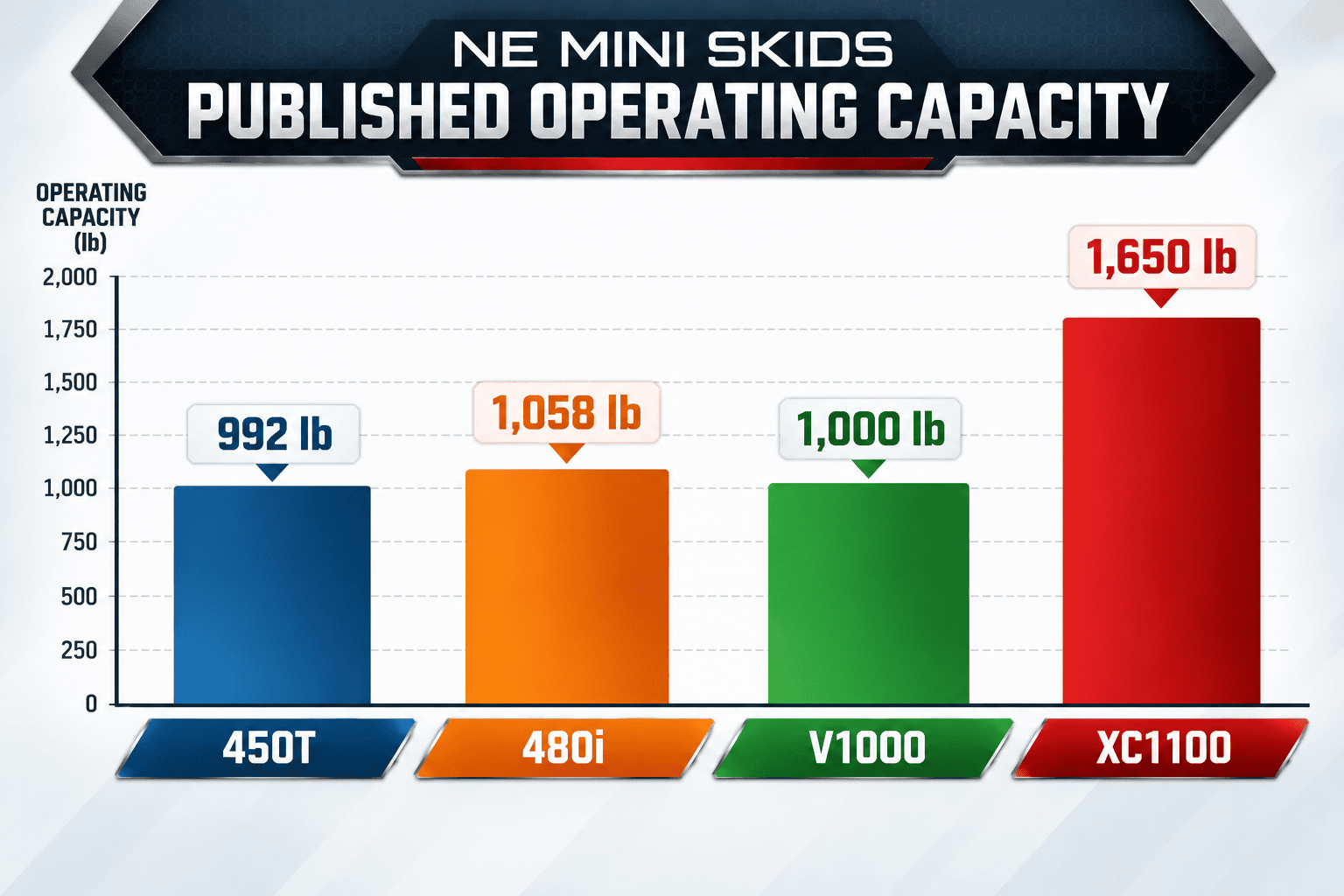
The 450T uses a 23-horsepower Honda gasoline engine, while the 480i is also listed with 23 available horsepower and a Honda gasoline engine. The V1000 moves into a 25-horsepower diesel configuration with Kubota or Perkins engine options, while the XC1100 uses a 25-horsepower Kubota D1105 diesel engine.
Notice something important in those numbers.
Machine progression isn't simply a straight line of increasing operating capacity.
The V1000, for example, is listed at a 1,000-pound operating lift capacity—slightly below the published 1,058 pounds of the 480i. Yet NE Mini Skids positions the V1000 for regular commercial use, heavier work cycles and contractors who prefer diesel.
That illustrates why choosing equipment from a single specification can be misleading.
Ask What You Are Actually Lifting
Instead of asking:
“How much can this machine lift?”
Ask:
“What do I routinely need this machine to lift, carry and position?”
A landscape contractor moving mulch and soil has different requirements from a hardscape contractor moving dense stone products.
A property-maintenance company moving brush has different requirements from a contractor handling palletized material.
Weight also isn't the entire story.
The shape of the load, attachment being used, load position, terrain and operating conditions all matter. Always follow the manufacturer's operating instructions and capacity limitations for the machine and attachment combination being used.
Also Read 📖Mini Skid Steer vs. Compact Track Loader: Which Do You Need?
Hydraulics: The Specification Buyers Should Not Ignore
Lift receives attention because it is easy to visualize.
Hydraulics can be easier to overlook.
That can be a costly mistake if attachments are a major reason you're buying the machine.
A mini skid steer becomes substantially more versatile when hydraulic attachments allow it to perform multiple jobs. Depending on machine compatibility and application, attachments can include equipment such as:
- Augers
- Trenchers
- Grapples
- Stump grinders
- Brush equipment
- Sweepers
- Snow equipment
- Grading attachments
NE Mini Skids offers attachment configurations for landscaping, hardscaping, excavation, utility work, property maintenance, land management and winter operations.
Hydraulic Demand Changes the Buying Decision
Not every attachment places the same demand on a hydraulic system.
This is why contractors should determine their attachment package before finalizing the machine purchase, rather than buying a machine first and investigating attachments later.
Ask:
What attachments will generate revenue for my business?
Then:
What does each attachment require from the machine?
An attachment that relies heavily on hydraulic performance can change which machine makes sense even if two models appear similar when comparing basic lifting numbers.
This is particularly important for contractors who want one power unit to replace several pieces of specialized equipment.
The value of a mini skid steer isn't merely that it carries a bucket.
Its real business value can come from becoming a multi-purpose attachment platform.
Also Read 📖Tracks vs. Wheels: Which Mini Skid Steer Is Better?
Machine Size: Bigger Can Actually Make You Less Productive
Here's where compact equipment gets interesting.
Suppose Machine A has more capacity than Machine B.
Machine A therefore sounds like the better investment—until you arrive at a property where Machine A cannot efficiently reach the work.
Now its additional capability means very little.
Mini skid steers are particularly valuable because they bring mechanized work into areas where larger equipment can be difficult or impractical to operate.
That makes physical dimensions part of the productivity equation.
Consider:
- Gates
- Walkways
- Existing landscaping
- Buildings
- Barns
- Fences
- Trees
- Utility corridors
- Residential backyards
- Finished surfaces
- Trailer limitations
- Equipment storage
NE Mini Skids has previously emphasized this principle in its guidance for New England contractors: the most productive machine is not necessarily the largest one; accessibility itself can create an operational advantage.
For contractors working primarily on residential properties, that distinction can be enormous.
If your business regularly depends on entering confined areas, compact access isn't a compromise. It is a specification.
Also Read 📖Are Oversized Machines Costing Contractors More on Small Jobsites?
Don't Forget Machine Weight
Machine weight deserves consideration for another reason: your mini skid does not magically arrive at the jobsite.
It has to be transported.
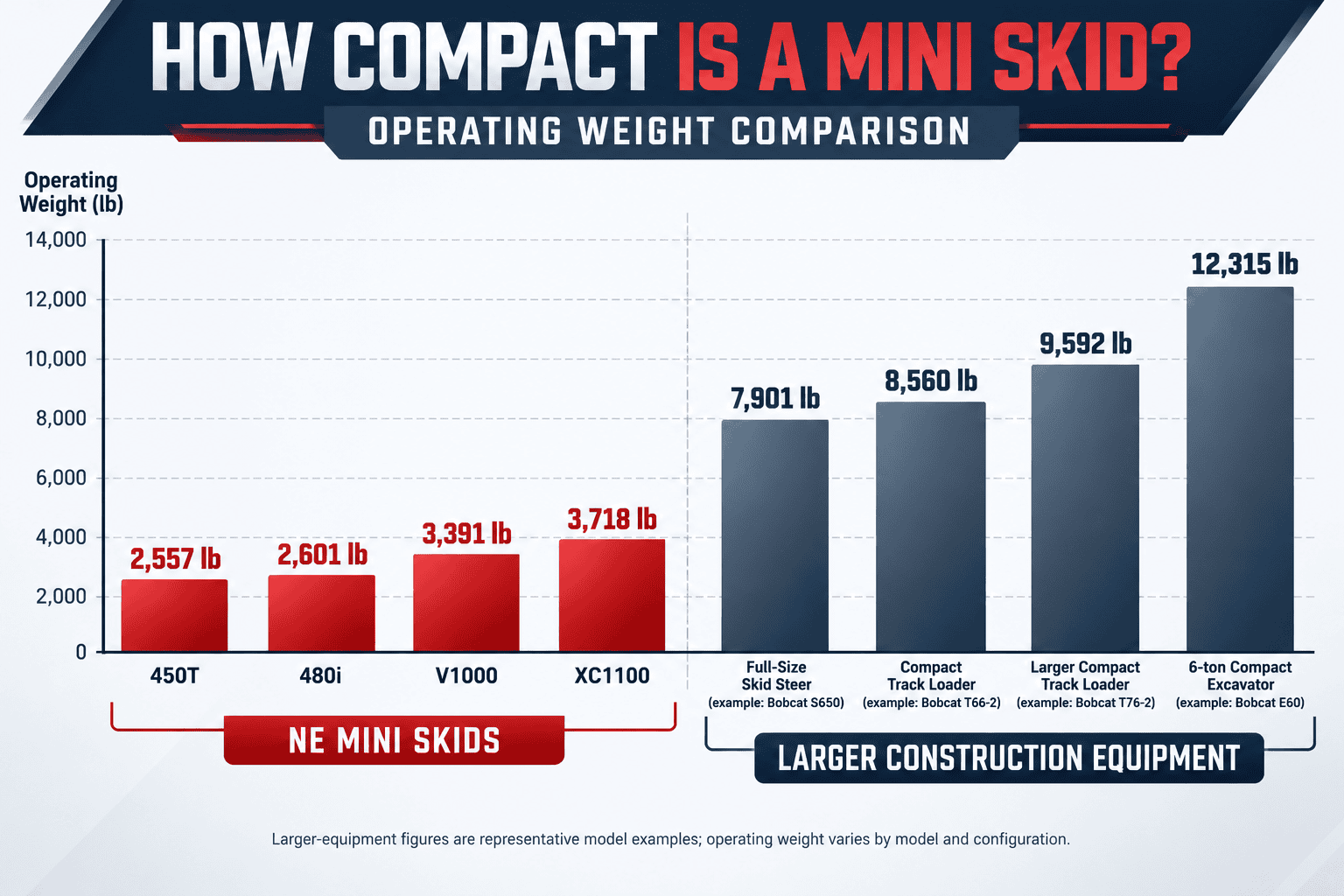
Those differences can affect the entire transportation setup.
Contractors should evaluate the complete transported load—not simply machine weight—including the trailer, attachments and other equipment being carried. Tow vehicle ratings, trailer ratings, load distribution and applicable transportation requirements all need to be considered.
A machine purchase can therefore trigger a second question:
Can my existing transportation setup safely and legally support the equipment package I want to buy?
Finding that answer before purchasing equipment is considerably better than discovering it afterward.
Match Machine Size to Work Cycle
Two contractors could perform similar jobs but need different machines because of frequency.
Imagine one property owner who uses a mini skid several hours each month.
Now compare that with a commercial contractor whose machine may work repeatedly throughout the week.
Those are different operating environments.
This is where buyers should think beyond individual jobs and consider duty cycle.
Ask:
- How many days each week will this machine work?
- How many hours might it operate?
- How frequently will it lift or move heavier material?
- How attachment-intensive is the workload?
- Will several employees use it?
- Will it generate revenue every week?
- Is downtime especially expensive for the business?
A professional contractor may choose a more robust platform not because every individual task requires it, but because the overall workload does.
Also Read 📖What is the best mini skid steer for landscaping and hardscaping?
The NE Mini Skids Lineup: Four Different Working Profiles
Instead of viewing the lineup as simply small, medium, large and larger, it is more useful to think about working profiles.
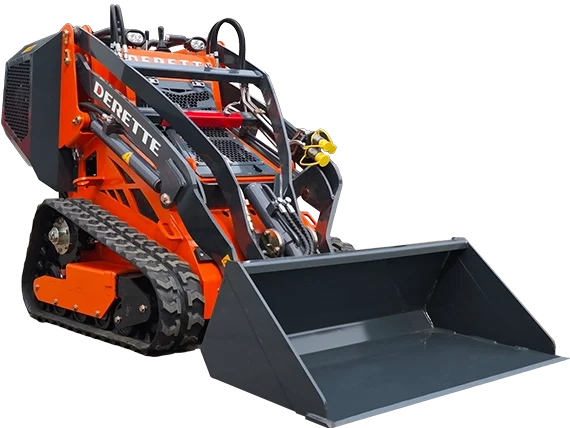
450T: Compact, Everyday Capability
NE Mini Skids positions the 450T for landscaping, residential property work, material handling, trenching and general contracting.
Its published operating lift capacity is 992 pounds, with a 23-horsepower Honda gasoline engine and overall weight of approximately 2,557 pounds.
This makes it worth considering for businesses where maneuverability and everyday compact-equipment versatility are priorities.
Think:
Residential access + routine material movement + general property work.
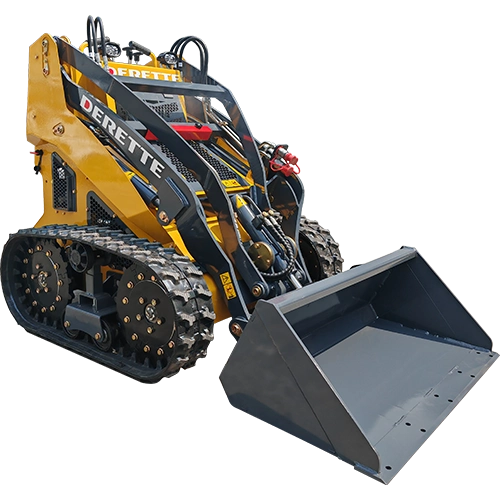
480i: Versatility for Mixed Work
The 480i increases published operating capacity to 1,058 pounds while retaining a 23-horsepower Honda gasoline configuration. NE Mini Skids describes its convertible design as providing flexibility for operation on soil or pavement.
It can be particularly relevant for contractors whose work varies from one project to another.
Landscaping today.
Drainage tomorrow.
Hardscaping next week.
General property improvement after that.
Think:
Versatility + mixed job conditions + growing contractor workload.
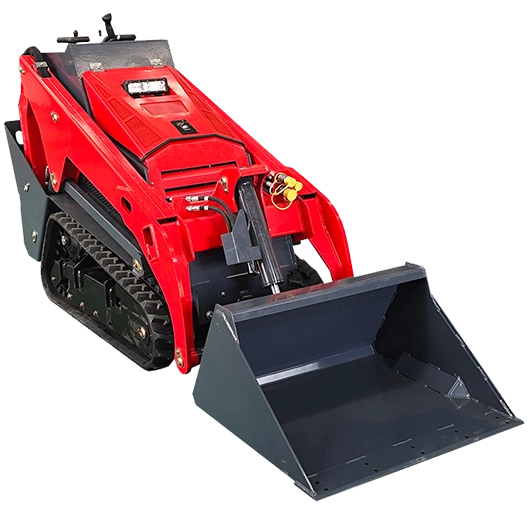
V1000: Moving Into Commercial Diesel Work
The V1000 changes the equation.
Its published operating capacity is 1,000 pounds, but focusing solely on that number misses its intended role.
The machine is offered with a 25-horsepower Kubota or Perkins diesel engine, weighs approximately 3,391 pounds and is positioned for regular commercial use, heavier work cycles, landscaping, site work and contractors who prefer diesel equipment.
This is an excellent example of why equipment selection should consider the whole machine instead of ranking models by one number.
Think:
Commercial workload + diesel platform + more demanding work cycles.
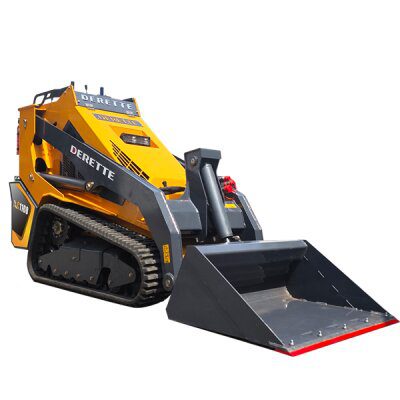
XC1100: When Greater Capacity Becomes Necessary
The XC1100 makes the largest jump in published operating capacity.
NE Mini Skids currently lists the machine at 1,650 pounds operating capacity, with a 25-horsepower Kubota D1105 diesel engine and an overall weight of approximately 3,718 pounds.
It is positioned for operators requiring greater lifting, stability, hydraulic capability or production.
That can make it appropriate for contractors handling more demanding material movement, construction, groundwork and higher-production applications.
Think:
Higher capacity + demanding attachments + heavier production requirements.
Five Questions to Ask Before Choosing Your Mini Skid
Before deciding which machine to purchase, write down the answers to these questions.
1. What is the heaviest material I routinely handle?
Focus on normal jobs rather than rare exceptions.
2. Which attachments will I use most?
Identify them before selecting the machine so hydraulic and compatibility requirements become part of the decision.
3. What is the narrowest access point on my typical jobsite?
Measure actual gates, paths and work areas when possible.
4. How will I transport the machine and attachments?
Consider the complete transportation package—not simply the machine itself.
5. What will my workload look like two years from now?
Buying only for today's smallest job may create another equipment purchase sooner than expected.
But don't automatically buy the largest machine you can afford either.
Buy for realistic growth.
Also Read 📖The Complete Guide to Buying a Mini Skid Steer: What Every Contractor Should Know Before Investing
So, What Size Mini Skid Steer Do You Need?
The answer isn't found in one specification.
It is found where your materials, attachments, access requirements and workload intersect.
For residential landscaping and everyday property work where compact maneuverability is a priority, the 450T may provide the capability needed.
For contractors performing a wider mixture of landscaping, hardscaping, property improvement and similar work, the versatility of the 480i may make more sense.
Businesses moving into regular commercial workloads or preferring a diesel platform should examine the V1000.
And when increased operating capacity, stability, hydraulic capability and production become recurring requirements, the XC1100 deserves consideration.
The objective isn't to buy the biggest mini skid steer.
And it isn't to buy the least expensive machine capable of completing today's job.
The objective is to buy enough machine to comfortably perform the work that makes your business money—without sacrificing the access, transportation and versatility that made a mini skid steer attractive in the first place.
That is how equipment becomes more than another purchase.
It becomes a productive part of the business.
Also Read 📖How Contractors Are Solving Labor Shortages with Compact Equipment in Maine
Not Sure Which Machine Fits Your Work?
Before choosing based on a specification sheet alone, talk through the work you actually perform.
New England Mini Skids can help contractors compare the 450T, 480i, V1000 and XC1100, evaluate attachment requirements and determine which machine configuration best matches the jobs their crews perform.
New England Mini Skids
8 Liberty Drive, Unit C
Hermon, Maine 04401
207-401-5131
Explore the current machine lineup and start comparing your options at NE Mini Skids.


Frequently Asked Questions
1. What size mini skid steer do I need?
The right mini skid steer size depends on what you routinely lift, the attachments you plan to operate, your jobsite access requirements, transportation setup, and how frequently the machine will be used. Rather than choosing the largest machine available, look for enough capacity and hydraulic capability to comfortably handle your normal workload while maintaining the maneuverability your jobs require.
2. How much can a mini skid steer lift?
Lift capacity varies considerably by machine. NE Mini Skids currently lists operating capacities ranging from 992 pounds for the 450T to 1,650 pounds for the XC1100. Always use the manufacturer's published ratings and operating instructions when determining whether a machine is appropriate for a particular load.
3. Is a higher lift capacity always better on a mini skid steer?
No. Higher lift capacity can be valuable for heavier materials, but it may come with a larger or heavier machine. Contractors should balance capacity against jobsite access, transportation, attachment requirements, terrain, and workload. A smaller machine that easily reaches your normal work area may be more productive than additional capacity you rarely use.
4. Why are hydraulics important when choosing a mini skid steer?
Hydraulics determine whether the machine can properly support compatible hydraulic attachments. Attachments can have different hydraulic requirements, so contractors planning to use augers, trenchers, grapples, stump grinders, brush equipment, or other hydraulic tools should evaluate attachment requirements as part of the machine-selection process.
5. Should I choose my attachments before buying a mini skid steer?
Ideally, yes. Identify the attachments you expect to use most frequently and verify their compatibility and requirements before selecting the machine. This helps prevent buying a mini skid steer that meets your lifting needs but does not adequately match the attachments that will generate revenue for your business.
6. Is a bigger mini skid steer more productive?
Not necessarily. Productivity depends on how well the machine matches the job. A larger machine may offer additional capacity, but a more compact machine may have an advantage on properties with narrow gates, walkways, established landscaping, buildings, or other access restrictions. Useful capacity is capacity you can actually get to the jobsite and put to work.
7. Should I choose a gas or diesel mini skid steer?
The answer depends on your workload and equipment preferences. Gas-powered machines can be well suited to many landscaping, property-maintenance, and general contracting applications, while contractors with regular commercial workloads may prefer a diesel platform. Consider operating frequency, job demands, maintenance practices, and the rest of your equipment fleet when comparing the two.
8. How does machine weight affect which mini skid steer I should buy?
Machine weight affects transportation as well as jobsite considerations. Buyers should account for the mini skid steer, trailer, attachments, and any additional equipment being transported. The tow vehicle, hitch, and trailer must all be appropriately rated for the complete load, and operators should follow applicable transportation and load-securement requirements.
9. How much extra capacity should I allow when choosing a mini skid steer?
Avoid choosing a machine that will routinely need to operate at the edge of its rated capabilities. Consider your typical materials, attachments, working conditions, and expected business growth. At the same time, buying substantially more machine than your work requires can add unnecessary size, weight, and transportation demands. Manufacturer ratings and operating instructions should always determine actual operating limits.
10. How do I compare the 450T, 480i, V1000, and XC1100?
Don't compare the NE Mini Skids models using lift capacity alone. Evaluate operating capacity, engine configuration, hydraulic and attachment requirements, machine dimensions and weight, jobsite access, transportation, and expected duty cycle together. The goal is to identify the machine whose overall capabilities best match the work your business performs most often.
Previous Article: Tracks vs. Wheels: Which Mini Skid Steer Is Better?
Next Article: Hydraulic Flow Explained: Why GPRM Matters More Than Many Mini skid Buyers Realize.


